Tomato Powdery Mildew
Author: Matthew DeBacco
Reviewed by: Shuresh Ghimire, Ph.D.
Associate Extension Educator
Extension Vegetable Specialist
Date of Publication: July 1, 2026
Introduction
Powdery mildew is a common fungal disease that impacts many plants. It is caused by mainly by Oidium neolycopersici and Leveillula taurica on tomatoes. These are obligate pathogens meaning they need living tissue to grow and develop. It is most prevalent on the leaves which can limit yields due to the negative impact on photosynthesis. When conditions are warm and dry (lack of rain) with moderate to high humidity, growers are most likely to see this disease on their plants. Initial onset can also be encouraged by fruit set stress on the plant and unlike what many people think, this disease does not require leaf wetness to cause infection.
Note: The species of powdery mildew that infect other plants like lilac may look similar macroscopically but are a different species, so there is no need to worry about cross infection.
Symptoms
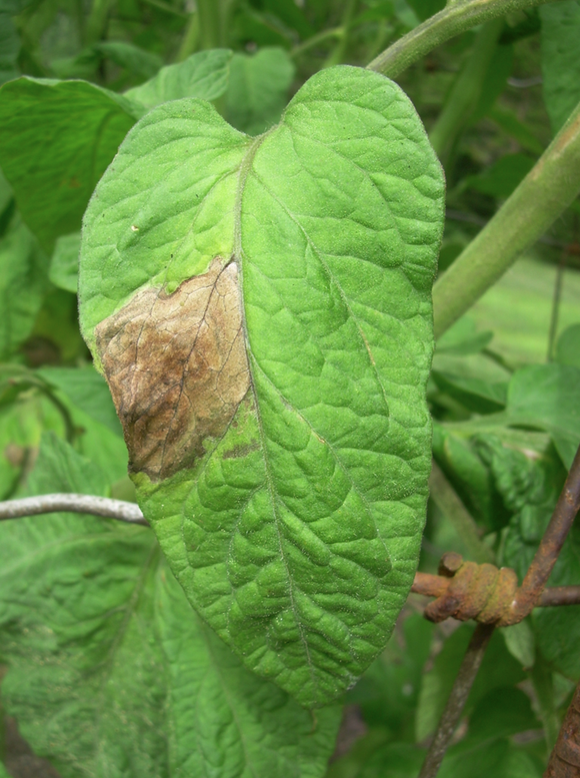
Early on there will be pale yellow, irregular blotches or spots on upper and/or under leaf surfaces, often starting on lower leaves. These will quickly progress to a white or faint gray powdery fuzz that is the spores and conidia of powdery mildew. The fuzz will start as isolated spots on the leaves that will not be limited by leaf veins. These isolated regions will expand to form larger colonies on the outer portion of the leaf.
Host Crops: Solanaceae family (Tomatoes, Peppers, Eggplant)
Identification of Disease
Powdery mildew thrives in warm, dry weather with moderate to high humidity levels but can be suppressed with rain. Optimum temperatures are 60–81°F (15–27°C) with infection occurring below 86°F (30°C). Higher temperatures may slow the disease spread and leaf death. Unlike many other foliar diseases, powdery mildew does not require leaf wetness. It spreads via windblown spores commonly prevalent in the late summer and early fall when temperatures are going through large fluctuations. Coastal areas that have fog, as well as high tunnels, can both be areas of increased disease pressure.
Prevention
Variety Selection
| Plum
Granadero F1 Indigo Rose |
Slicers
Climstar F1 Frederik F1 Rebelski F1 Striped Stuffer |
Cultural
Space plants 24”+ to improve air circulation and reduce humidity.
Avoid planting in shady or lower fields know to have late season fog.
Inspect transplants and discard plants from a propagation area that are not intended on being used.
Consult New England Vegetable Management Guide for a list of labeled products.
References
Blogs.cornell.edu. (n.d.). Powdery mildew on tomatoes. Cornell University. https://blogs.cornell.edu/livegpath/gallery/tomato/powdery-mildew-on-tomatoes/
Extension.oregonstate.edu. (n.d.). Managing powdery mildew on greenhouse tomato in western Oregon (EM 9413). Oregon State University Extension Service. https://extension.oregonstate.edu/catalog/pub/em-9413-managing-powdery-mildew-greenhouse-tomato-western-oregon
Lucidcentral.org. (n.d.). Tomato powdery mildew. Lucidcentral. https://apps.lucidcentral.org/pppw_v10/text/web_full/entities/tomato_powdery_mildew_314.htm
Pnwhandbooks.org. (n.d.). Tomato (Solanum lycopersicum) - powdery mildew. Pacific Northwest Pest Management Handbooks. https://pnwhandbooks.org/plantdisease/host-disease/tomato-solanum-lycopersicum-powdery-mildew
Purdue University. (n.d.). Tomato diseases. Agricultural Economics, Purdue University. https://ag.purdue.edu/department/arge/swpap/tomato-diseases.html
Ucanr.edu. (n.d.). Powdery mildew on greenhouse and coastal tomatoes. University of California Agriculture and Natural Resources. https://ipm.ucanr.edu/agriculture/tomato/powdery-mildew-on-greenhouse-and-coastal-tomatoes/#gsc.tab=0
Consult and follow pesticide labels for registered uses. To avoid potential phytotoxicity problems, spot test before widespread use. No discrimination is intended for any products not listed.
The information in this document is for educational purposes only. The recommendations contained are based on the best available knowledge at the time of publication. Any reference to commercial products, trade or brand names is for information only, and no endorsement or approval is intended. UConn Extension does not guarantee or warrant the standard of any product referenced or imply approval of the product to the exclusion of others which also may be available. The University of Connecticut, UConn Extension, College of Agriculture, Health and Natural Resources is an equal opportunity program provider and employer.