Tomato Leaf Mold
Author: Matthew DeBacco
Reviewed by: Shuresh Ghimire, Ph.D.
Associate Extension Educator
Extension Vegetable Specialist
Date of Publication: July 1, 2026
Introduction
Tomato leaf mold is caused by the non-obligate fungus Passalora fulva that thrives in conditions with humidity above 85% and temperatures between 68–77°F, commonly found in high tunnels. This fungus can cause leaves to yellow and reduce overall yield. The fungus spreads by spores that can survive for 6 months to 1 year and can be carried by wind, water, or tools. The fungus can survive on infected plant debris or even seeds.
Leaf mold is less common outdoors but can occur during periods of prolonged leaf wetness and high humidity, especially in regions with cool, damp weather. The pathogen can undergo multiple generations within a single growing season, with new spores forming on the lower leaf surface within 10 to 12 days under favorable conditions.
Symptoms
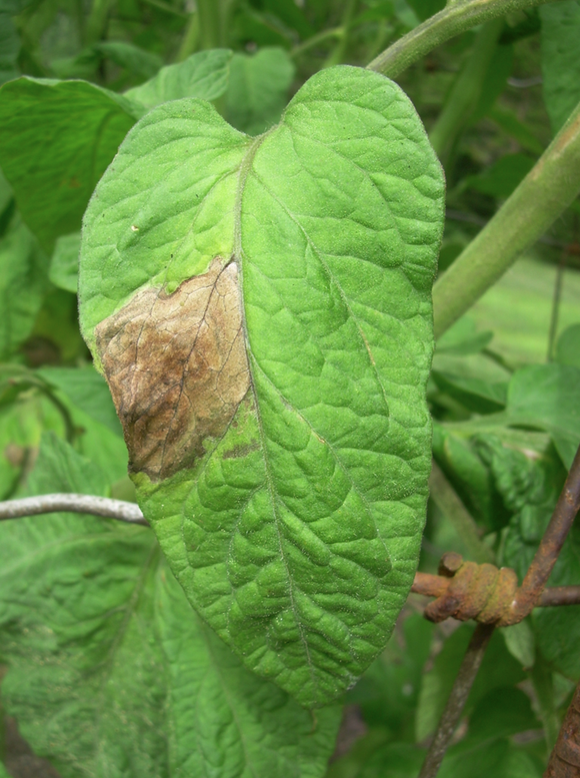
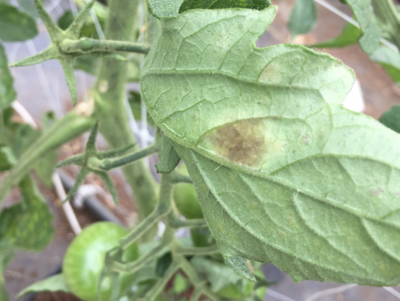
The disease typically shows as pale green to yellowish spots on the upper leaf surface, which may turn bright yellow or brown. On the underside, a velvety olive-green to brown mold develops. Over time, leaves may wither, die, and drop, and in severe cases, it can affect blossoms and fruit, causing them to rot.
Host Crops: Solanaceae family (Tomatoes, Peppers, Eggplant)
Identification of Disease
Leaf mold starts as light green to yellowish spots on the upper surface of the leaves, but the key is to look at the corresponding lower leaf surface where a velvety mold develops, ranging from olive-green to brownish in color, which consists of asexual conidia. This is typically found on the lower (older) leaves that can work its way up the plant. In advanced stages blossoms may turn black and fall off, and fruit can develop smooth, black, irregular areas at the stem end, becoming sunken, dry, and leathery, which can lead to post-harvest rot.
Not to Be Confused with:
Magnesium Deficiency- Tends to show first on the lower leaves and can remain in this area of the plant.
Gray Mold (Botrytis)- Impacts the stems of the plant and upon close inspection will also have a fuzzier appearance.
Prevention
Variety Selection
| Apero F1 (Cherry)
Bartelly F1 (Cherry) Braveheart F1 (Cherry) Edox F1 (Cherry) Ella Bella (Cherry) Favorita F1 (Cherry) Fonzi’s Pinky (Cherry) Micro Tom (Cherry) Nature’s Bites F1 (Cherry) Rossini (Cherry) Sakura F1 (Cherry) Sunpeach F1 (Cherry) Sweet Treats F1 (Cherry) Toronjina F1 (orange) (Cherry) |
Bellastar (Grape)
Conde (Grape) Golden Sweet F1 (yellow) (Grape) Mistral (Grape) Moni (Grape) Oribustar (Grape) Pareso F1 (Grape) Rozestar (Grape) Scarlet Star (Grape) Sweet Elite F1 (Grape) Sweet Hearts F1 (Grape) |
Caiman F1 (Heirloom)
Margold F1 (Heirloom) Apero F1 (Plum) Rugby (Plum) Bendida (Slicer) Beorange F1 (Slicer) Bigdena F1 (Slicer) Bolzano F1 (Slicer) Braveheart F1 (Slicer) Caiman F1 (Slicer) Climstar F1 (Slicer) Cubalibre (Slicer) Enroza F1 (Slicer) Frederik F1 (Slicer) |
Geronimo F1 (Slicer)
GinFiz F1 (Slicer) Grandma’s Little Girl F1 (Slicer) Komeett F1 (Slicer) Lemon Boy Plus F1 (Slicer) Maitai F1 (Slicer) Marnouar F1 (Slicer) Marvori F1 (Slicer) Orangaro F1 (Slicer) Pink Wonder F1 (Slicer) Purple Zebra (Slicer) |
Rebelski F1 (Slicer)
Red Boar F1 (Slicer) RuBee Dawn (Slicer) Think Pink (Slicer) Tomimaru Muchoo F1 (Slicer) Torero F1 (Slicer) Arnold F1 (rootstock) DRO141TX F1 (rootstock) Estamino F1 (rootstock) Fortamino F1 (rootstock)
|
Cultural
Improve Air Circulation: Space plants adequately, stake or trellis them to enhance airflow, and prune excess branches and dead leaves to reduce humidity around the plant. Locate rows parallel to prevalent wind direction in open areas to facilitate drying.
Reduce Humidity: Use fans in greenhouses, ensure proper ventilation, and avoid overhead watering to minimize leaf wetness. Maintain night temperatures higher than outside in greenhouses to reduce condensation.
Sanitation: Remove and destroy infected plant material promptly to prevent spore spread. Sanitize tools, equipment, and greenhouse structures between seasons to eliminate surviving spores. Practice good garden sanitation by removing fallen leaves and debris.
Crop Rotation and Site Management: Rotate crops and avoid planting tomatoes in the same location for at least one year to reduce soil-borne inoculum. Move high tunnels regularly to prevent re-infection from residual spores.
Spray Products
Consult New England Vegetable Management Guide for a list of labeled products.
References
Cornell University. (n.d.). Tomato leaf mold. Cornell Vegetables. https://www.vegetables.cornell.edu/pest-management/disease-factsheets/tomato-leaf-mold/
University of Minnesota Extension. (n.d.). Tomato leaf mold. https://extension.umn.edu/disease-management/tomato-leaf-mold
Consult and follow pesticide labels for registered uses. To avoid potential phytotoxicity problems, spot test before widespread use. No discrimination is intended for any products not listed.
The information in this document is for educational purposes only. The recommendations contained are based on the best available knowledge at the time of publication. Any reference to commercial products, trade or brand names is for information only, and no endorsement or approval is intended. UConn Extension does not guarantee or warrant the standard of any product referenced or imply approval of the product to the exclusion of others which also may be available. The University of Connecticut, UConn Extension, College of Agriculture, Health and Natural Resources is an equal opportunity program provider and employer.