Tomato Aphids
Author: Matthew DeBacco
Reviewed by: Shuresh Ghimire, Ph.D.
Associate Extension Educator
Extension Vegetable Specialist
Date of Publication: June 29, 2026
Introduction
Aphids are sap-sucking insects that create a threat to many crops due to the typical overwhelming numbers in part because of the rapid rate of reproduction that can cover a plant and cause long lasting damage despite their small physical size. Not only is there the physical damage but aphids have the ability to effectively transmit many plant viruses. There are many different species of aphids, but the ones of greatest economic concern are potato aphid (Macrosiphum euphorbiae), green peach aphid (Myzus persicae), and glasshouse potato aphid (Aulacorthum solani).
Symptoms
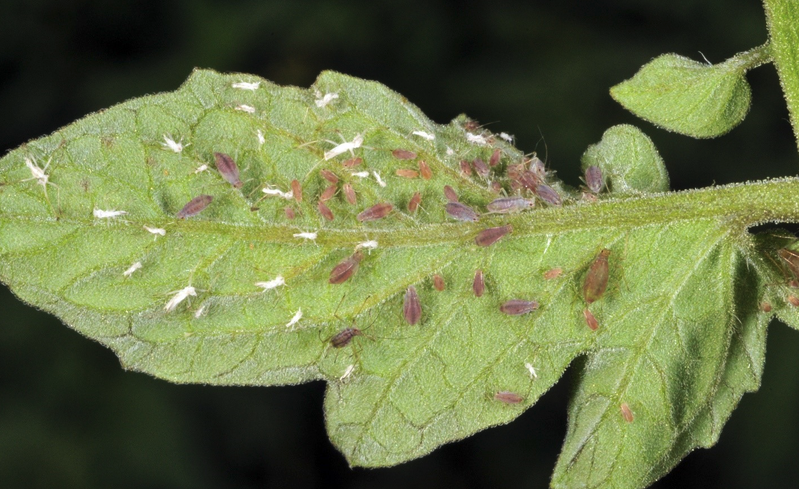
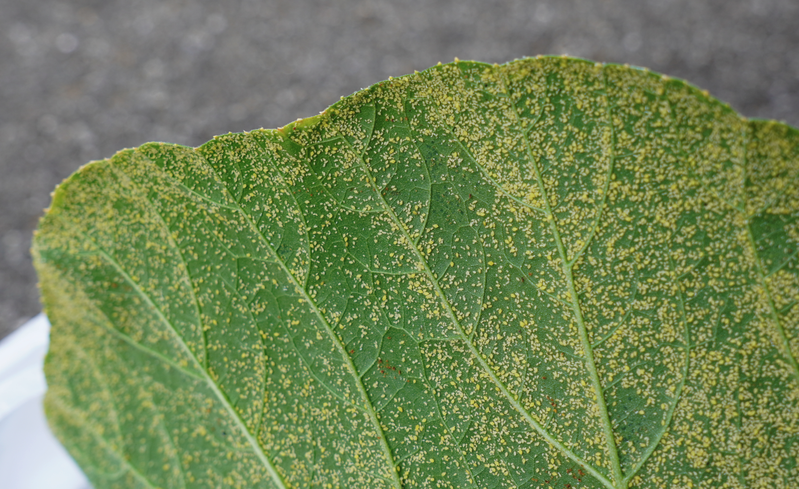
Most growers' first sign of an infestation is leaf distortion which can present as leaf curl, yellowing or stunted appearance. Another visual indication of aphid feeding is the presence of “honey dew” which is the sticky sap released by the aphids. In other instances, gray to black sooty appearance can be left by the aphids feeding on the plant. During this feeding the aphids can transmit viruses causing infection to the plant that will cause long term damage, which the site of activity will have stunted growth.
In some cases, growers may notice concentrated ant and/or honeybee activity to the leaves of the plant as these insects are attracted to the honeydew that is left directly by the aphids feeding.
Host Crops: Wide variety including…
Solanaceous Crops (tomatoes, potatoes, peppers, eggplant, tobacco)
Cucurbits: (watermelons, squash)
Other Vegetables: (Lettuce, beans, spinach, cabbage)
Ornamentals (nasturtiums, sunflowers, roses)
Fruit Trees (apples, peaches)
Identification of Insects
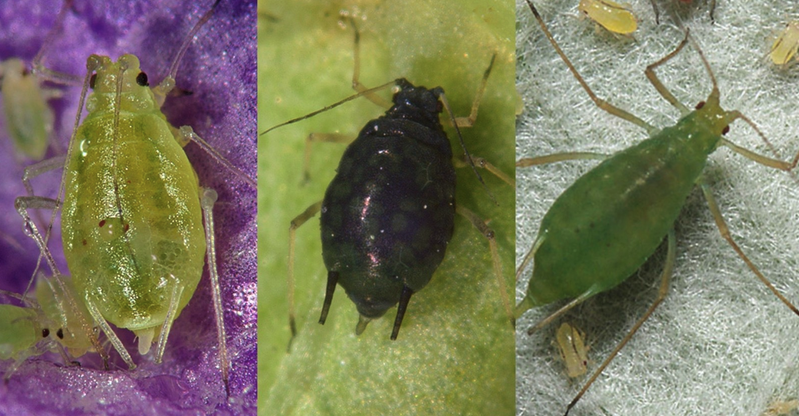
The actual aphids can have a wide variance of colorations, with green and black being the most common, but yellow and mottled variations do exist. What is consistent is the small pear-shaped bodies that are 1/16 to 1/8” long. Using a handheld loupe can help to see the insects better for identification. Looking at the undersides of leaves is a likely spot to find the aphids. Upon closer inspection, looking at the abdomen, two tube-like structures called cornicles can typically be seen. Growers may also notice white cast skins which are the result of aphids molting.
Management
Cultural
Trap crop plantings of nasturtiums or sunflowers can help concentrate early aphid populations to help focus scouting and control efforts.
Avoid excessive nitrogen fertilizers as this can speed up the aphid reproduction rate.
Biological
Encouraging natural predators such as ladybugs, lacewings and parasitic wasps can provide effective control, if there are pollen rich plants in the area to ensure the predators are in the area before the aphid number increase.
Mechanical Approaches
Reflective (chrome color) mulches can help reduce pressure, but growers have reported mixed reviews on this, however, if putting down weed suppression mulch this is an option to consider.
Spray Products
Check the New England Vegetable Management Guide for specific crop insect management section.
References
Cooperative Extension Service, University of Kentucky. (n.d.). Aphids on home garden and landscape plants (ENTFACT-313). https://entomology.ca.uky.edu/ef313
Oklahoma State University Extension. (n.d.). Common diseases of tomatoes: Part II. Diseases caused by bacteria, viruses, and nematodes (EPP-7626). https://extension.okstate.edu/fact-sheets/common-diseases-of-tomatoes-part-ii-diseases-caused-by-bacteria-viruses-and-nematodes.html
Royal Horticultural Society. (n.d.). Aphids. https://www.rhs.org.uk/biodiversity/aphids
University of California Agriculture and Natural Resources. (n.d.). Green peach aphid. https://ipm.ucanr.edu/agriculture/tomato/green-peach-aphid/#gsc.tab=0
University of Massachusetts Amherst. (n.d.). Aphids on greenhouse crops. https://www.umass.edu/agriculture-food-environment/greenhouse-floriculture/fact-sheets/aphids-on-greenhouse-crops
University of Minnesota Extension. (n.d.). Aphids in home yards and gardens. https://extension.umn.edu/yard-and-garden-insects/aphids
Utah State University Extension. (n.d.). Aphid pests on vegetables. https://extension.usu.edu/planthealth/research/aphid-pests-on-vegetables
Utah State University Extension. (n.d.). Aphids: Vegetable guide for tomato, pepper, eggplant. https://extension.usu.edu/vegetableguide/tomato-pepper-eggplant/aphids
Washington State University Extension. (n.d.). Tomato: Aphids (FS059E). https://hortsense.cahnrs.wsu.edu/fact-sheet/tomato-aphids/
Consult and follow pesticide labels for registered uses. To avoid potential phytotoxicity problems, spot test before widespread use. No discrimination is intended for any products not listed.
The information in this document is for educational purposes only. The recommendations contained are based on the best available knowledge at the time of publication. Any reference to commercial products, trade or brand names is for information only, and no endorsement or approval is intended. UConn Extension does not guarantee or warrant the standard of any product referenced or imply approval of the product to the exclusion of others which also may be available. The University of Connecticut, UConn Extension, College of Agriculture, Health and Natural Resources is an equal opportunity program provider and employer.