Scouting & Observations
- Cucumber Beetles
- Squash Bugs
- Angular Leaf Spot
- Continue to be on the lookout for Allium Leafminers, Aphids,
Colorado Potato Beetles, Corn Earworm, Flea Beetles, Potato
Leafhoppers, European Corn Borer, Squash Vine Borer, Scarab
Beetles, Cabbage Root Maggot, Onion Thrips and Mites
Upcoming Events & Opportunities
- 7/1, 7/16, 8/6 - Twilight Urban Farming Cut Flower Series
- 7/7 - Vegetable IPM Field Workshop
- 7/8 - Cut Flower Pests and Diseases Skill Share
- 7/22 - Commercial Vegetable Pests and Diseases Skill Share
- 8/5 - Plant Science Day with CAES
Cucumber Beetles
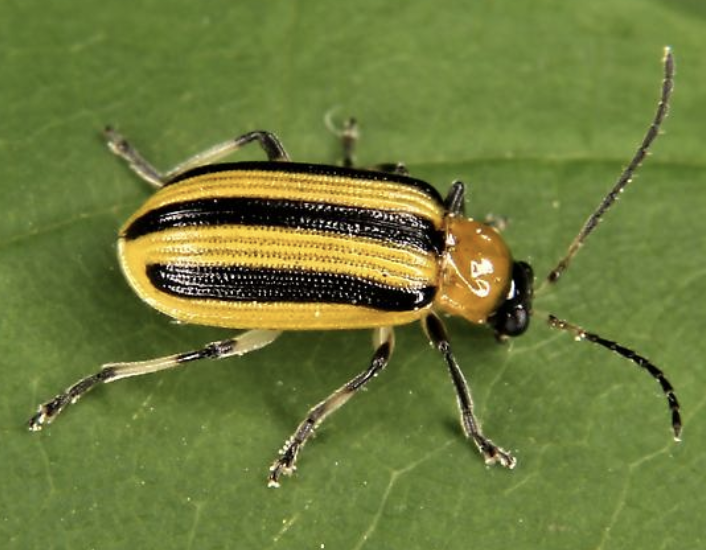
Striped cucumber beetles (SCB) adults have three black stripes, a yellow thorax, and a black head. They cause foliar damage as they feed and can be a vector for devastating diseases like bacterial wilt and squash mosaic virus. Adult beetles may also congregate in flowers, potentially damaging fruit.
Spotted cucumber beetles, also known as southern corn rootworm (SCR) are often found in cucurbit flowers. Adults are yellowish green with 12 black spots on their back. They feed on a wide range of crops and weeds and rarely build up to damaging levels in New England, and when they do, they largely pose a threat to younger plants. Adults cause direct feeding damage to cotyledons, leaves and the base of the stem, while larvae feed on plant roots. Their feeding is also a source for spreading bacterial wilt.
Cucumbers and muskmelons are highly susceptible to bacterial wilt. Treat these crops if one cucumber beetle is found for every two plants. Butternut squash, watermelon, and most pumpkins are less susceptible to bacterial wilt and can tolerate 1-2 beetles per plant. There aren’t many bee-friendly options for chemical control, so get populations under control early on to prevent the need to spray during flowering or consider spraying in the evening after bees have stopped foraging. Learn more about reducing the risk to pollinators.
The most effective OMRI-listed material is pyrethrin (e.g. Pyganic). Small plants can also be protected using kaolin clay (e.g. Surround), which needs to be reapplied to protect new growth. If you are applying a contact spray, target adult beetles in the evening when they are less active. For crops most susceptible to bacteria wilt, a systemic insecticide may be more effective. Systemic insecticides can be applied to the seed or the seedling root zone during or after planting/transplanting.
See the New England Vegetable Management Guide for more information on insect control for cucurbit crops.
Squash Bugs
Squash bugs are most attracted to zucchini, yellow summer squash, and pumpkins. Both adults and nymphs feed on plant tissue and can cause the whole plant to wilt. They will also feed on fruits resulting in scarring and impacting their marketability. Symptoms like plant wilt, leaf yellowing, and plant stunting can sometimes be mistaken for squash vine borer. Inspect the stem for an entry hole and frass from the borer to differentiate. Squash bugs can be vectors for cucurbit yellow vine decline, a bacterial disease that has been found in isolated places in CT and MA.
Scout the undersides of leaves for squash bug adults and eggs and treat if egg masses exceed 1 per plant. Adults often hide around the base of the plant or under plastic mulch, making them hard to target with sprays. Eggs are usually deposited on the leaves in an organized, neatly spaced pattern, in groups of 10 to 20. Time squash bug sprays to kill young nymphs which are easiest to control. Thorough coverage is necessary. As emergence often coincides with the bloom period, treat late in the day to reduce risk to bees and select products with lower bee toxicity.
See the New England Vegetable Management Guide for a page on insect control for pumpkin, squash and gourds for spray options.
Angular Leaf Spot
All cucurbits are susceptible to angular leaf spot, but it is most commonly seen on cucumbers. It appears early in the season because it is seed-borne. Symptoms include small, round, water-soaked spots on the leaf tissue that expand until they are confined by veins, giving them the characteristic angular appearance.
Under moist conditions, a milky white fluid containing bacterial cells may ooze out of the lesion on the lower leaf surface. These wet-looking spots will dry out and turn yellow-brown, or the dead tissue may fall out of the leaf altogether, leaving a “shot-hole”. Yellowing of the leaf between lesions may occur where disease severity is high. Similarly, water-soaked spots may appear on stems and petioles, drying out to form a whitish crust.
Water-soaked spots may also appear on fruit. These spots are small and dry out to form whitish, chalky spots. They cause internal decay of fruit, and fruit that is infected early may be deformed. Affected plants will grow poorly and produce less fruit. The affected fruit is also unmarketable.
To control the spread of the disease, avoid working in the fields when the foliage is wet. Work in clean sections of the field first and infected sections last to avoid spreading the disease to (so far) unaffected plants. If you catch the disease early, before it is widespread and severe, copper may reduce the spread. However, sprays may not be effective if environmental conditions are conducive to the spread of the disease. Till in residues quickly after harvest to encourage a quick breakdown of infected plant tissue. Bacteria can survive on plant residue as long as it is present, up to two years.
Continue to be on the lookout
The following pests that were covered in the previous pest alerts and are still relevant in current conditions:
- Allium Leafminer
- Aphids
- Colorado Potato Beetles
- Corn Earworm
- Cucumber Beetles
- European Corn Borer
- Flea Beetles
- Potato Leafhoppers
- Cabbage Root Maggot
- Onion Thrips
- Mites
Upcoming Events & Opportunities
Twilight Urban Farming Cut Flower Series
Join UConn Extension's Urban Agriculture Team for a series of unique hands on learning experiences while touring urban flower farms.
#1 - An Urban Lavender Farm
July 1st, 6:30PM - 8PM
Sunshine Lavender Farm, Waterbury
>> Register for Series #1
#2 - From Seed to Flower
July 16th, 6:30PM - 8PM
The Hickories, Ridgefield
>> Register for Series #2
#3 - Intensive Production
August 6th, 6:30PM - 8PM
Backyard Blooms, Trumbull
>> Register for Series #3
This series is free to attend. All are welcome! Please contact Angela Lopez-Tejada if you have any questions.
Vegetable IPM Field Workshop
Tuesday, July 7th, 2026
3:30pm to 6:30pm
UConn Plant Science Research and Education Facility
This free workshop, led by UConn specialists, covers a range of agricultural topics and will include a cover crop and soil sampling demonstration, IPM monitoring using the NEWA system, update on squash variety trials and cucumber beetle management, hands-on white grub identification training, and report on sweet corn fertilizer trials. Pesticide recertification credits in PA and 1A categories are pending approval.
Solid Ground Summer Skill Shares
Cut Flowers: Pests & Diseases
July 8th, 4pm to 6:30pm
Off Center Farm, Woodbridge
Commercial Vegetables: Pests & Diseases
July 22nd, 4pm to 6:30pm
Handel Family Farm, East Hartford
These Skill Shares will focus on building good scouting habits and identification skills to correctly identify the cause of a problem. Using an active farm as our classroom, facilitators will guide participants on scouting walks, illustrating what to look for, frequency of inspections, tools and traps, describing good record keeping, and thresholds for taking action. Cost of each event to attend is $15, dinner included!
Save These Dates!

116th CAES Plant Science Day
Wednesday, August 5th, 2026
Lockwood Farm, 890 Evergreen Ave, Hamden

2026 New England Vegetable & Fruit Conference
December 15, 16, 17, 2026
Manchester, New Hampshire

2027 UConn Extension Vegetable and Small Fruit Growers Conference
Tuesday, January 12th, 2027
UConn Student Union, Storrs, CT
Coming Soon
Stay in touch with us
- Share what you see: We're here to assist with identification, management strategies, and guidance on best practices. Send us a photo/message via iMessage at 959-929-1031.
- Facebook Group: UConn Extension moderates a private Facebook group specifically for commercial vegetable producers. It is a space to share photos of insects and diseases you find in your fields, ask questions, share ideas, and stay engaged with growers across the state.
Join the "UConn Extension - Vegetable IPM" Facebook Group - Schedule a consultation: Would you benefit from meeting with an Extension Specialist at your farm to provide insight on pest or disease identification, management strategies, and more? If so, please contact our Vegetable Extension Specialist, Shuresh Ghimire, to setup a farm visit. Contact him at shuresh.ghimire@uconn.edu or 860-870-6933.
Contact Information
Shuresh Ghimire, Vegetable Extension Specialist: shuresh.ghimire@uconn.edu
Nicole Davidow, Vegetable Extension Outreach Assistant: nicole.davidow@uconn.edu
Vegetable IPM Office Phone Number:
860-870-6933
Vegetable IPM Cell Phone Number:
959-929-1031 (feel free to text/iMessage photos)
Any reference to commercial products, trade or brand names is for information only, and no endorsement or approval is intended. Always read the label before using any pesticide. The label is the legal document for product use. Disregard any information if it is in conflict with the label. UConn Extension does not guarantee or warrant the standard of any product referenced or imply approval of the product to the exclusion of others which also may be available. The University of Connecticut, UConn Extension, College of Agriculture, Health and Natural Resources is an equal opportunity program provider.