Quick Links
Scouting & Observations
- Preparing for Powdery Mildew in Summer Squash and Fungal Leaf Spots in Tomatoes
- Solanaceous Flea Beetles
- Aphids on Tomatoes and Eggplant
- Corn Earworm
- Continue to be on the lookout for Allium Leafminers, Colorado Potato Beetles, Potato Leafhoppers, Striped Cucumber Beetles, European Corn Borer, Cabbage Root Maggot, Onion Thrips and Mites
Upcoming Events & Opportunities
- Updated modules, open enrollment: Farm Risk Management Course
- 6/16 - Cover Crop Drone Seeding Workshop
- 6/24 - Solid Ground's Chicken Tractor Design Discussion
- 7/7 - Vegetable IPM Field Workshop
- 8/5 - Plant Science Day with CAES
Preparing for Powdery Mildew in Summer Squash and Fungal Leaf Spots in Tomatoes
The forecast for Connecticut calls for hot, humid weather with scattered thunderstorms and possible heavy downpours in the coming days. These conditions are important for vegetable disease management. High humidity and dense crop canopies favor powdery mildew development in cucurbits, while thunderstorms and leaf wetness favor splash-dispersed tomato leaf spots such as early blight/Alternaria and Septoria.
Summer squash: powdery mildew
Fungicides should be applied at the first sign of disease (or earlier with some products). Begin scouting for powdery mildew at fruit initiation. On cucurbits, the disease has a white powdery appearance and infects both the top and bottom of the leaf, making it more difficult to control with non-systemic fungicides. However, powdery mildew fungi tend to become resistant to systemic fungicides such as Topsin-M (Group 1) and Cabrio, Flint Extra, Quadris, and Sovran (Group 11). Resistances to Group 1 and Group 11 fungicides have resulted in the removal of these classes of fungicides from recommendations, with the exception of Pristine which is a combination product. Resistance to the DMI fungicides (Rally, Procure - Group 3) is also widespread; use Rally or Procure at the high labeled rate only.
The most effective contact fungicides are sulfur, mineral oil, and chlorothalonil. For organic production, options include sulfur, mineral oil/JMS Stylet-Oil, potassium bicarbonate, neem oil, Regalia, Double Nickel, and similar labeled products, but many organic materials work best preventively and require excellent coverage.
With the forecasted heat, be careful with sulfur and oils. Sulfur can injure plants when temperatures approach 90°F, and oils can also cause crop injury under hot or drought-stressed conditions. If using sulfur, oil, or other organic contact materials, apply during cooler parts of the day and follow label restrictions on temperature, crop safety, and mixing intervals.
Tomatoes: Alternaria/early blight and Septoria leaf spot
Tomato growers should also prepare for early blight and Septoria leaf spot, especially in fields with a history of these diseases. Both diseases often start on lower leaves and move upward. Rain splash, wet foliage, dense canopy, and old crop debris all increase risk. Stake and prune where appropriate, mulch to reduce soil splash, avoid overhead irrigation if possible, maintain good airflow, and remove lower diseased leaves when practical.
In fields with a history of early blight or Septoria, begin fungicide applications before disease is evident, usually when first fruit are about half grown or around the first week of July. However, if disease is already present or if repeated storms and long leaf wetness occur earlier, begin earlier. Where possible, use TOMCAST or NEWA disease-forecasting tools to time sprays based on local weather.
Preventive fungicide options for conventional tomatoes include protectant materials such as chlorothalonil and mancozeb, copper products, and premixes or rotational partners. Chlorothalonil and mancozeb are important protectants because they are multi-site fungicides and useful for resistance management. For organic tomatoes, copper products are the main preventive option, with some biological products labeled for suppression; however, organic materials are protectants and will not “clean up” established disease.
Under wet, humid, stormy conditions, maintain a regular protective schedule, commonly 7–10 days depending on disease pressure, product label, rainfall, and forecast. Shorten intervals when disease pressure is high or after heavy rain if the label allows. Extend intervals only when weather is dry and disease risk is low. Focus on protecting new growth and maintaining lower-canopy coverage, where these diseases usually begin.
Solanaceous Flea Beetles
Solanaceous flea beetle feeds primarily on eggplant, tomato, pepper and potato crops, along with some weeds including black nightshades. They leave a characteristic small shot hole injury to the leaves. Potatoes, once well established, can withstand considerable feeding damage. However, eggplants are vulnerable even at later stages. Treat newly set transplants if they have 2 flea beetles per plant, seedlings 3" to 6" tall if they have greater than 4 beetles per plant, and plants over 6" tall if they have 8 beetles per plant.
Row cover or exclusion netting can be used to exclude flea beetles early in production and before flowers develop. Spinosad (e.g. Entrust) is the most effective material for organic growers but cannot be applied more than 2x consecutively; pyrethrin (e.g. Pyganic) will provide a quick knockdown of flea beetle for organic growers as well. Other chemical control include pyrethroids (e.g. Azana XL, Baythroid XL, Brigadier, Bifenture, Mustang Maxx, Warrior II), and Admire Pro (soil treatment only). See the New England Vegetable Management Guide for more spray options.
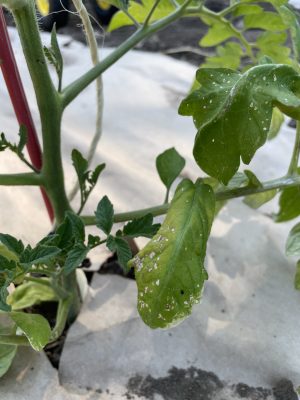
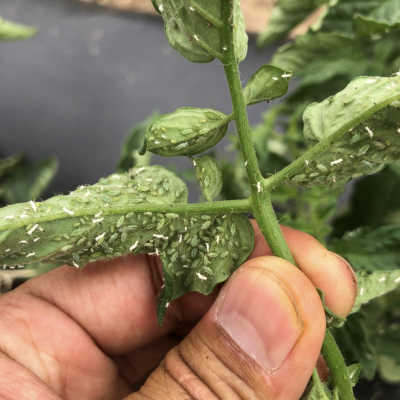
Aphids on Tomato & Eggplant Crops
Different species of aphids prefer different parts of tomato plants. For example, potato aphids typically start in young new plant growth, moving down the plant as population size increases. Green peach aphids on the other hand will start in the lower leaves. Scout weekly across the field, sampling 3 leaves per plant at lower, mid, and upper levels. Count aphid adults and nymphs and note if numbers are increasing. Treat when aphids exceed 6 per leaf. Beneficials generally (NOT always) keep aphids under control in tomato, unless broad spectrum insecticides are used for other pests. DO NOT use emulsifiable concentrates on tomatoes setting young fruit, or injury may occur. See the New England Vegetable Management Guide for spray options on tomatoes.
Aphids generally colonize eggplant crops during the first two weeks of July. Good control early on with a selective insecticide will prevent the need for sprays later in the season. Good coverage of the underside of leaves is important. Treat when 1-2 aphids per leaf are observed. Be aware that broad-spectrum insecticide applications can cause aphid and mite outbreaks by reducing the populations of beneficial organisms. See the New England Vegetable Management Guide for spray options on eggplant.
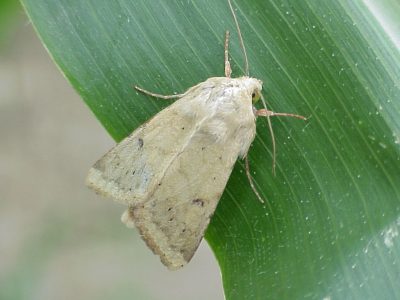
Corn Earworm
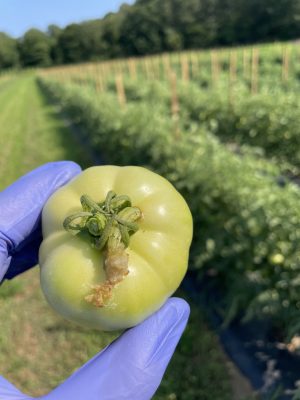
Corn earworm (CEW) moths annually migrate into the Northeast, traveling north on storm fronts, and typically arrive anytime from late June through September. However, they seem to be flying earlier in recent years and have already been spotted in surrounding states including NY, MA and even further north in NH. CEW feeds on a wide range of crops and among vegetables, corn and tomato are heavily favored (hence it is also known as ‘tomato fruitworm’).
Moths/Week Spray Intervals when using Heliothis Net Traps
If you are only seeing about 1 moth per week, it is not yet worth spraying. If you catch an average 1.4-3.5 moths per week, begin spraying at 6 day intervals. Increase to spraying every 5 days if numbers grow between 3.5-7.5 moths per week. Increase to spraying every 4 days if numbers grow between 7-91 moths per week. If you are catching over 91 moths in one week, increase sprays to every 3 days.
Reference Documents:
Sweet Corn Pest ID & Trapping Factsheet
See the New England Vegetable Management Guide for more details on management strategies for sweet corn insect pests.
Continue to be on the lookout
The following pests that were covered in the previous pest alerts and are still relevant in current conditions:
- Allium Leafminer
- Colorado Potato Beetles
- Cucumber Beetles
- European Corn Borer
- Potato Leafhoppers
- Cabbage Root Maggot
- Onion Thrips
- Mites
Upcoming Events & Opportunities
Cover Crop Drone Seeding Workshop
Tuesday, June 16th, 2026
10AM to 12PM
Valleyside Farms, 210 Child Hill Road, Woodstock, CT
This workshop is designed to demonstrate interseeding cover crop by drone into standing silage corn systems as an alternative to conventional post-harvest drill seeding. Topics to be discussed include cover crop planting date, seeding rate, planting strategy, species, and residue management. Refreshments will be provided.
Vegetable IPM Field Workshop
Tuesday, July 7th, 2026
3:30pm to 6:30pm
UConn Plant Science Research and Education Facility
This free workshop, led by UConn specialists, covers a range of agricultural topics and will include a cover crop and soil sampling demonstration, IPM monitoring using the NEWA system, update on squash variety trials and cucumber beetle management, hands-on white grub identification training, and report on sweet corn fertilizer trials. Pesticide recertification credits in PA and 1A categories are pending approval.
116th CAES Plant Science Day
Wednesday, August 5th, 2026
10AM to 4PM
Lockwood Farm, 890 Evergreen Ave, Hamden
The event will feature: Barn Displays, Field Plots and Exhibits, Technical Demonstrations, Plant Diagnosis and Plant Identification, Insect Identification, Questions Answered, Activities for Kids, Lockwood Farm Walking Tour, All About Apples Walking Tour, Connecticut Pesticide Credits Offered - All Categories and Private Applicator (PA) Categories: 3.75 Total Credit Hours.
Save These Dates!

2026 New England Vegetable & Fruit Conference
December 15, 16, 17, 2026
Manchester, New Hampshire

2027 UConn Extension Vegetable and Small Fruit Growers Conference
Tuesday, January 12th, 2027
UConn Student Union, Storrs, CT
Stay in touch with us
- Share what you see: We're here to assist with identification, management strategies, and guidance on best practices. Send us a photo/message via iMessage at 959-929-1031.
- Facebook Group: UConn Extension moderates a private Facebook group specifically for commercial vegetable producers. It is a space to share photos of insects and diseases you find in your fields, ask questions, share ideas, and stay engaged with growers across the state.
Join the "UConn Extension - Vegetable IPM" Facebook Group - Schedule a consultation: Would you benefit from meeting with an Extension Specialist at your farm to provide insight on pest or disease identification, management strategies, and more? If so, please contact our Vegetable Extension Specialist, Shuresh Ghimire, to setup a farm visit. Contact him at shuresh.ghimire@uconn.edu or 860-870-6933.
Contact Information
Shuresh Ghimire, Vegetable Extension Specialist: shuresh.ghimire@uconn.edu
Nicole Davidow, Vegetable Extension Outreach Assistant: nicole.davidow@uconn.edu
Vegetable IPM Office Phone Number:
860-870-6933
Vegetable IPM Cell Phone Number:
959-929-1031 (feel free to text/iMessage photos)
Any reference to commercial products, trade or brand names is for information only, and no endorsement or approval is intended. Always read the label before using any pesticide. The label is the legal document for product use. Disregard any information if it is in conflict with the label. UConn Extension does not guarantee or warrant the standard of any product referenced or imply approval of the product to the exclusion of others which also may be available. The University of Connecticut, UConn Extension, College of Agriculture, Health and Natural Resources is an equal opportunity program provider.