Quick Links
Scouting & Observations
- Aphids, Mites and Thrips on Transplants
- Brassica Flea Beetles
- Asparagus Beetles
- Purple Leaves on Seedlings
Upcoming Events & Opportunities
- Job Opening: Food Systems Communications & Outreach Assistant
- 4/29 - Solid Ground Farmland Seeking Skill Share
- 4/30 - Ground Covers and Mulches for Small Scale Urban Producers
- 5/2 - Leaf Shredding For Sustainable Mulch Workshop
- 5/7 - Small-Scale Poultry Processing Webinar
- 5/16 - Northeast SARE Programs and Practice Guidance on Vegetable Growing and Pest Management
- 5/21 - UConn Extension Diversified Livestock Conference
- 5/28 and 5/29 - FSMA Produce Safety Rule/PSA Grower Training Course
- 5/31 (Submissions Due) - Small Farms Innovation Project
Aphids, Mites and Thrips on Transplants
Many vegetable crops are grown from transplants in Connecticut. Transplants enable growers to get the most out of a short growing season and can assist in getting a harvestable crop as soon as possible. Regular scouting is necessary when starting seedlings in greenhouses as unchecked pest pressure can spiral, stressing young plants, creating wounds or other environmental conditions for disease to take hold, and diminishing the overall health of transplants.
Aphids
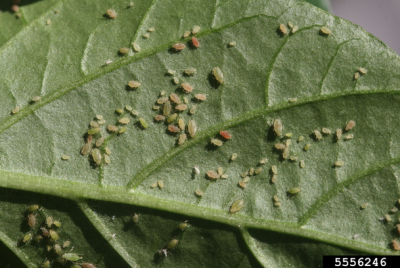
Several species of aphids can occur on vegetable transplants, but the most common are green peach, melon, foxglove, and potato. Aphids feed by inserting their piercing, sucking mouthparts into plant tissue and removing fluids. In greenhouses, aphids are usually females. Each female can produce 50 or more nymphs. Nymphs mature to adulthood and begin reproducing in as little as 7-10 days. Adult aphids are usually wingless, but some will produce wings when populations reach outbreak levels. Large numbers of aphids will stunt and deform plants. Physically removing wingless aphids by shaking the plant or spraying with water can help since they will have a hard time climbing back up onto their host plant.
In addition to feeding damage, aphids are also problematic because they can transmit certain viruses. Aphids also produce a sticky digestive by-product called honeydew that covers leaves and provides a food source for a superficial black fungus known as "sooty mold." Signs of aphid activity include shed white skins (sometimes mistaken for white flies), shiny honeydew, curled new leaves, distorted growth, and the presence of ants. Examine plant foliage, stems and new growth – especially in key plants such as pepper, eggplant, brassica crops, and leafy greens – to detect potential aphid infestation as early as possible.
Mites
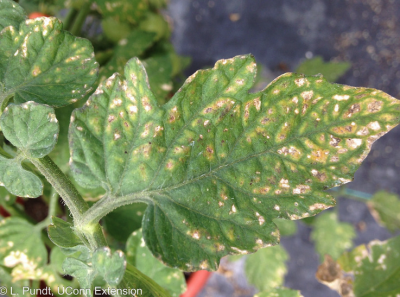
There are three main types of mites that threaten transplants in the greenhouse: broad mites, spider mites, and cyclamen mites. Because they are small and the undersides of leaves, on new growth, or within tender buds or flowers, they can be challenging to detect. Look for inward curling leaves, puckering and crinkling. You can also use a hand lens or microscope to look within buds for mites and their eggs. Spider mites will create webbing and discolored foliage like light flecking or speckling when high populations have developed.
Mites can be controlled chemically or biologically. One of the most common strategies for combatting problematic mites in the greenhouse is through predatory mites.
Thrips
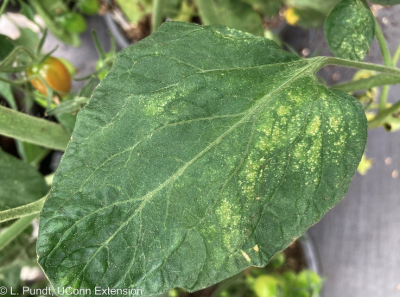
Thrips easily go undetected until considerable damage is done since they are small, feed in plant buds, and multiply rapidly. Feeding marks appear as white streaks on leaves and infested new plant growth may curl under or cause deformed leaves. Look for distorted young leaves and silvery flecked scars as signs of feeding damage. Female thrips insert several hundred eggs into plant tissue, and the tiny, yellowish larvae will feed on plant fluids as they mature. Warmer temperatures cause development and maturity to quicken. Eggplant, tomato, pepper and leafy greens are all prone to thrips infestations.
Yellow sticky cards should be placed just above the crop canopy, near doors and vents, and over thrips-sensitive cultivars to monitor their movement. It’s important to detect thrips as early as possible, because damage will only continue once seedlings are transplanted in the field.
Please see insecticides labeled for insects and mites on vegetable transplant. You can find a table listing such insecticides on the New England Vegetable Management Guide website.
Brassica Flea Beetles
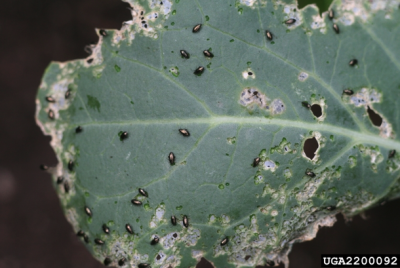
Brassica flea beetles will soon be active. Adult beetles overwinter outside cropped fields, in the soil surface and decaying plant residue of shrubby or woody borders. They search out host crops from early May into June and feed on leaves and stems, leaving small round pits and holes. Eggs are laid in soil near the plant. Tiny white larvae feed on root hairs and pupate underground. New adults emerge from mid-July through early August and feed throughout August.
Crops with more waxy leaves (Brassicas such as cabbage, broccoli, and kale) are less attractive and feeding is more restricted to leaf margins, especially as crop matures. Crops with glossy leaves (e.g. bok choy, Napa cabbage, or mustard greens) are highly attractive. The whole leaf is susceptible to damage, making the crop susceptible until harvest. Be sure to protect direct-seeded crops and young transplants with a row cover or chemical control. Non-waxy brassica crops can be planted alongside waxy brassicas and sprayed regularly to function as a trap crop and reduce sprays to less preferred crops. A working threshold of 1 beetle per plant or >10% average leaf damage on 50% of the plants has proved effective in leafy greens and early stages of heading brassicas. Repeated applications may be needed if pressure is high. A list of labeled products can be found in the New England Vegetable Management Guide. Spinosad (e.g. Entrust) is an effective OMRI-listed material. Kaolin clay (e.g. Surround) will protect young transplants but needs to be frequently reapplied to cover new growth and will wash off in rain.
Asparagus Beetles
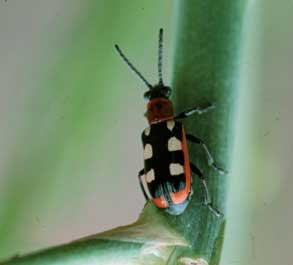
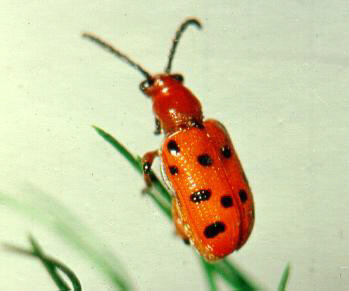
The emergence of asparagus every spring coincides with the renewed presence of asparagus beetles. There are two beetle pests of asparagus, the common asparagus beetle (CAB) and the spotted asparagus beetle (SAB). They overwinter as adults in protected areas along fields, feed and lay eggs in the crop, pupate in the soil, and have two or sometimes three generations per year. Depending on the size of the population and intensity of pest pressure, common asparagus beetle larvae may cause severe defoliation of ferns and lead to the decline of the planting. On the other hand, spotted asparagus beetle larvae feed only on berries. This can weaken the plant in the fall and lead to a lower yield the following year.
During harvest, scout for adults and eggs on sunny afternoons. Treat spears if >10% of the plants are infested with beetles or 1-2% have eggs or damage. If possible, spot spray to help conserve natural enemies. During harvest, snap or cut spears close to the soil surface daily. A tiny metallic green wasp, Tetrastichus asparagi, parasitizes asparagus beetle eggs. They have been known to provide very effective control, parasitizing up to 70% of the eggs. Lady beetle larvae and other predators may also be active; they will consume both eggs and larvae as well as asparagus aphids. Entrust, PyGanic, Suffoil, or Radiant can be sprayed. Surround WP may also work as a repellent. For more information on insecticide applications for asparagus beetles, please refer to the NE Vegetable Management Guide.
Purple Leaves on Seedlings: Cold Stress v. Low Soil Phosphorus
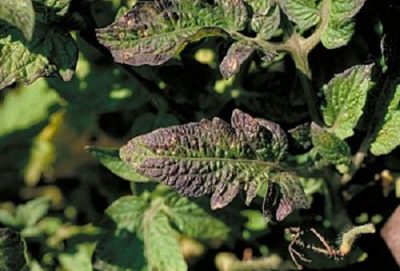
You may be noticing that some recent transplants are showing purple leaves and dark foliage. In many cases, this is a temporary phosphorus deficiency caused by cold soils, not a true lack of phosphorus in the soil. Cold conditions slow root growth and limit phosphorus uptake, especially in young plants.
Typical symptoms include purpling or reddish-purple color, often first seen on older leaves, along with slow growth or stunting. These symptoms are usually most noticeable in cold, wet, or compacted soils.
Do not assume that every purple seedling needs more fertilizer. In many cases, the best response is to let soils warm and watch how new growth develops. It is also worth checking for wet areas, soil compaction, and poor root development. If symptoms continue after warmer weather arrives, confirm the problem with a soil or media test before making fertilizer decisions.
Upcoming Events & Opportunities
Solid Ground Skill Share for Farmland Seekers
Wednesday, April 29th
4PM to 6:30PM
Ives Farm, Cheshire
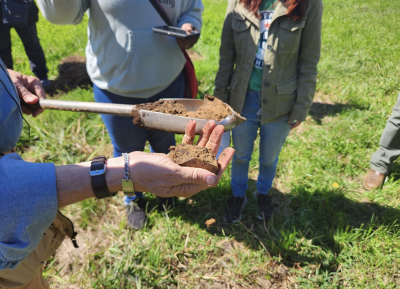
Join Solid Ground's Soil, Conservation and Land Use Consultant Kip Kolesinskas for a a farm tour and demonstration of how to go about assessing farmland using key areas of interest such as property history, soil health, infrastructure, water features.
The event will include a walk of the property, overview of farmland considerations, introductions to service providers, and more. Dinner will be provided. Cost to attend: $15.
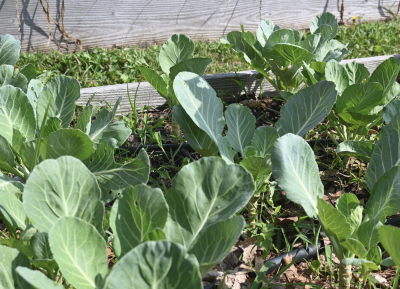
Ground Covers and Mulches for Small Scale Urban Producers
Thursday, April 30th
6:30PM to 7:30PM
Virtual Event
Hear from Shuresh Ghimire, UConn Extension Vegetable Specialist, on how ground covers and mulches can improve soil health, conserve moisture, suppress weeds, and boost productivity in small urban growing spaces.
This webinar will highlight practical, space-efficient strategies for using mulches and living ground covers in raised beds, containers, and compact garden plots—helping urban producers build healthier and more sustainable growing systems.
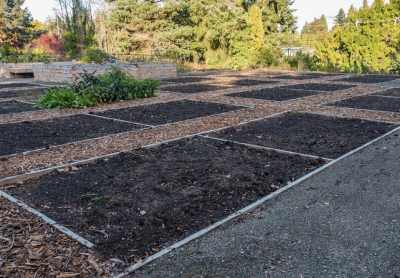
Leaf Shredding for Sustainable Mulch Workshop
Saturday, May 2nd
2:00PM to 3:00PM
Keney Park, 183 Windsor Ave, Windsor
Join Sarah Rose from Samad Gardens Initiative for a demonstration and application of an electric leaf shredder for easy leaf mulch application. Participants will see the leaf shredder in action, learn how to assemble and use it, and produce bagged mulch to spread on the prepped planting beds at Keney Park Sustainability Project. Participants will also discuss tools and options for practical application of leaf mulches to garden beds, and the benefits to soil health and farm and garden success. Parking is available at the Windsor entrance to Keney Park. Free street parking on Norman Ave.

Small-Scale Poultry Processing Webinar
Thursday, May 7th
3:00PM to 4:00PM
Virtual Event
Many people are interested in opening a poultry processing facility to meet this need, but many things need to be considered before proceeding to do so. Dr. Indu Upadhyaya will discuss common issues and important considerations for small-scale processing.
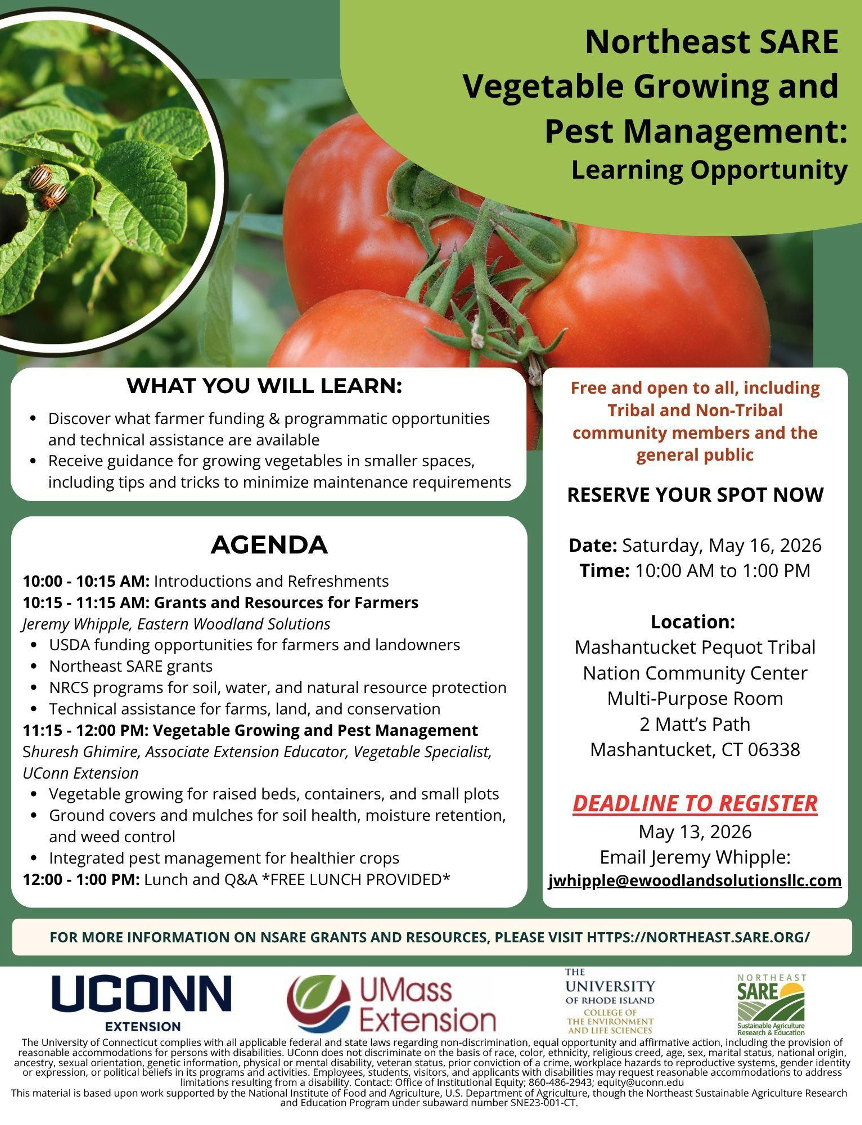
Northeast SARE Learning Opportunity
10:00 AM – 1:00 PM
Mashantucket Pequot Tribal Nation Community Center
Join us for a FREE workshop focused on Northeast SARE programs and opportunities, along with practical guidance on Vegetable Growing & Pest Management. Learn about grant opportunities, funding programs, and resources available to support farmers, growers, and community projects.Additional topics include:
- Growing strong, healthy vegetables all season
- Managing pests with effective, low-impact methods
- Tools and support available for growers
Email jwhipple@ewoodlandsolutionsllc.com to register.
This workshop is open to Tribal and non-Tribal community members, as well as the general public. Lunch will be provided during the Q&A session.
Come learn how to access funding, strengthen your growing practices, and connect with available resources. Feel free to share!
UConn Extension Diversified Livestock Conference
Thursday, May 21st
9:00AM to 5:00PM
Tolland Agricultural Center
In partnership with Berkshire Agricultural Ventures, please join us for the first UConn Extension Diversified Livestock Conference! The day will feature presentations on meat processing, prescribed grazing, small-scale poultry production, sheep farming in CT, and a deep dive into product taste testing.
FSMA Produce Safety Rule/Produce Safety Alliance (PSA) Approved Grower Training Course
May 28th and 29th, 2026
9:00AM to 3:00PM
The Produce Safety Alliance (PSA) Grower Training Course has been designed to provide a foundation of Good Agricultural Practices knowledge that includes emphasis on co-management of food safety and environmental management goals, while outlining the requirements of the Food Safety Modernization Act (FSMA) Produce Safety Rule.
Cost to attend: $50. Technology required: Computer software for ZOOM, audio, video, and internet.

Small Farms Innovation Project - Financial and Technical Support for Tools, Infrastructure, and Environmental Impact Ideas
Submissions due May 31st, 2026
The Small Farms Innovation Project, put forward by the UConn Engineering Department in partnership with CT RC&D and NCTFA, is gearing up for its third year and is looking for farmers interested in problem-solving or prototyping their innovative farm ideas by teaming up with engineering students. Participation and supply stipends available for accepted farmers.
Save These Dates!

UConn IPM Field Day
Tuesday, July 7th, 2026
3:30PM to 6:30PM
UConn Research Farm

2026 New England
Vegetable & Fruit Conference
December 15, 16, 17, 2026
Manchester, New Hampshire

2027 UConn Extension Vegetable and Small Fruit Growers Conference
Tuesday, January 12th, 2027
UConn Student Union, Storrs, CT
Stay in touch with us
- Share what you see: We're here to assist with identification, management strategies, and guidance on best practices. Send us a photo/message via iMessage at 959-929-1031.
- Facebook Group: UConn Extension moderates a private Facebook group specifically for commercial vegetable producers. It is a space to share photos of insects and diseases you find in your fields, ask questions, share ideas, and stay engaged with growers across the state.
Join the "UConn Extension - Vegetable IPM" Facebook Group - Schedule a consultation: Would you benefit from meeting with an Extension Specialist at your farm to provide insight on pest or disease identification, management strategies, and more? If so, please contact our Vegetable Extension Specialist, Shuresh Ghimire, to setup a farm visit. Contact him at shuresh.ghimire@uconn.edu or 860-870-6933.
Contact Information
Shuresh Ghimire, Vegetable Extension Specialist: shuresh.ghimire@uconn.edu
Nicole Davidow, Vegetable Extension Outreach Assistant: nicole.davidow@uconn.edu
Vegetable IPM Office Phone Number:
860-870-6933
Vegetable IPM Cell Phone Number:
959-929-1031 (feel free to text/iMessage photos)
Any reference to commercial products, trade or brand names is for information only, and no endorsement or approval is intended. Always read the label before using any pesticide. The label is the legal document for product use. Disregard any information if it is in conflict with the label. UConn Extension does not guarantee or warrant the standard of any product referenced or imply approval of the product to the exclusion of others which also may be available. The University of Connecticut, UConn Extension, College of Agriculture, Health and Natural Resources is an equal opportunity program provider.