Introduction
Springtails are very common insects that are abundant in soils with high organic matter. They are often not noticed because of their very small size. They are generally considered beneficial because of their role as nutrient recyclers in the soil; however, some species such as the garden springtail can occasionally damage tender, young seedlings. The target audience of this fact sheet is commercial greenhouse growers.
Biology and Life Cycle
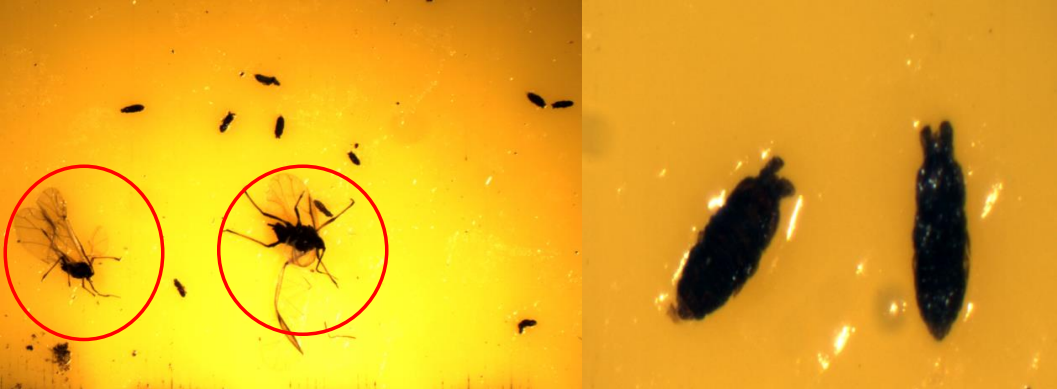
Springtails are very small (~1/16 inch to 1/8 inch in length) six-legged arthropods (Collembola) without wings. Their color varies from white, gray, black, brown, or purple. Many, but not all, species have a specialized fork-like structure (“furcular”) that they use to jump or hop like flea beetles.
Springtails are found in growing media with high levels of organic matter or compost, especially if plants have been overwatered. Springtails lay their eggs in moist soil. Their eggs hatch in about 10 days and they molt multiple times throughout the season. Adults may live through the year.
Feeding Damage
Springtails are generally beneficial feeding upon dead plant matter, fungi, bacteria, and other soil microbes. Some are predators of nematodes in the soil.
Occasionally, high populations of garden springtails feed on leaves of tender young seedlings producing tiny pits on the leaf surface. This feeding damage resembles that of flea beetles. High tunnel growers may notice feeding damage during during dry soil conditions when the springtails are seeking moisture. Garden springtails have been reported feeding on beans, beets, broccoli, cabbage, cantaloupe, cauliflower, celery, cucumber, lettuce, onion, pumpkin, radish, spinach, squash, tomato, and watermelon.
Monitoring
Springtails may be spread in unpasteurized potting soil, via plant contact or may simply move indoors into the greenhouse from nearby habitats.
If abundant, growers may notice the springtails hopping on the growing media surface after watering. Springtails may occasionally be caught on yellow sticky cards.
When growers are holding plants horizontally and then tapping the plants over a sheet of white paper, to monitor for thrips, springtails may drop from the growing media unto the paper. Sometimes, growers confuse springtails with thrips larvae.
Management
Sanitation is helpful in managing high populations of springtails. They are commonly found in areas of high humidity and moisture levels. Avoid over watering and let the media dry down between irrigation. The predatory mite, Stratiolaelaps scimitus feeds upon springtails as well as other soil dwelling insects.
Disclaimer for Fact Sheets: The information in this document is for educational purposes only. The recommendations contained are based on the best available knowledge at the time of publication. Any reference commercial products, trade or brand names is for information only, and no endorsement or approval is intended. UConn Extension does not guarantee or warrant the standard of any product referenced or imply approval of the product to the exclusion of others which also may be available. The University of Connecticut, UConn Extension, College of Agriculture, Health and Natural Resources is an equal opportunity program provider and employer.