Fungus gnats (Bradysia spp.) develop in moist environments common in greenhouses, especially in propagation houses. The target audience of this factsheet is commercial greenhouse growers.
Identification
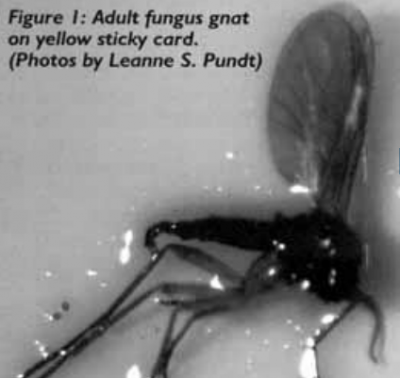
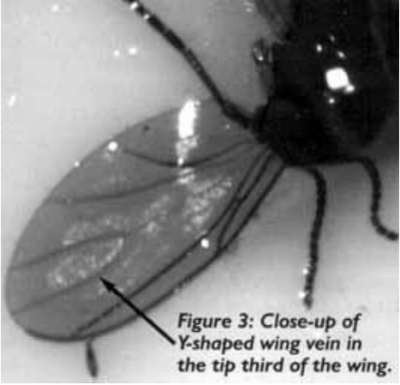
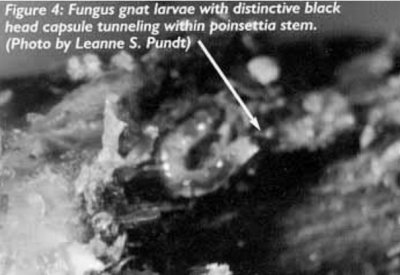
Adult fungus gnats are small (1/8-inch-long), mosquito-like insects, with long legs and antennae. (Figure1) Their two wings are delicate and clear with a Y-shaped vein in the wing pattern. (Figure 3) Adults are weak flyers and tend to fly in a zig-zag pattern. They may be observed resting on the growing media surface or moving across lower leaves. Adult females are attracted to fungi so might be observed near plants with Botrytis sporulation. Females lay their eggs nearby, so the developing larvae have access to a fungal food source. Fungus gnat larvae are small, (approximately ¼ of an inch long when mature), translucent to white in color with a distinctive black head capsule (Figure 4).
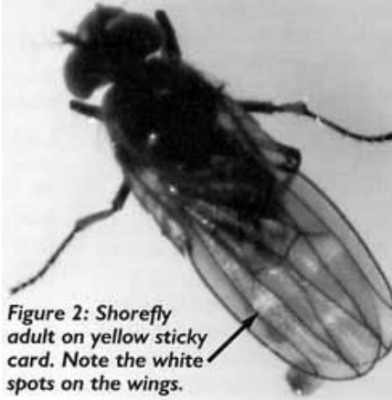
Both fungus gnats and shore flies occur in the greenhouse. However, it is important to distinguish between the two, because management strategies differ. Shore fly adults (approximately 1/8 of an inch long), resemble a small housefly with stockier bodies, plus shorter legs, and antennae than fungus gnats. Shore flies also have five distinct white spots, which fungus gnats do not have. Shore fly larvae are white, wedge-shaped and do not have a distinctive head capsule. Larvae are often found near algae, a primary food source. They do not feed on plants.
Fungus Gnat Damage
Fungus gnat larvae feed on fungi and decaying organic matter, but also feed upon plant roots. This larval feeding is most damaging to seedlings, and young plants. Larvae also feed on the developing callus of direct stuck cuttings, delaying rooting. Fungus gnat larvae are general feeders. Plants with succulent stems, such as begonias, geraniums, sedum, coleus, and poinsettias, are especially prone to injury and can suffer serious losses. As the young feeder roots and stems are
damaged, plants wilt and leaves turn yellow and drop. In laboratory studies, adult fungus gnats carried spores of Botrytis, Verticillium, Fusarium and Thielaviopsis as they moved from plant to plant. Spores have also been found in their droppings. However, it is unclear how important disease transmission is in commercial greenhouses.
Biology and Life Cycle
The fungus gnat's life cycle from egg to adult may be completed in 21 to 28 days depending on temperature. Eggs are laid in cracks and crevices in the media surface and hatch in four to six days. Fungus gnat larvae feed and develop for about two weeks at 72o F. Pupation occurs in the soil. After four to five days, adults emerge. Overlapping and continuous generations make control difficult.
Scouting
Monitoring is especially crucial when using biological controls or insect growth regulators against the fungus gnat larvae. Inspect incoming plugs for fungus gnat larvae or their damage. Place yellow sticky cards in samples of growing media to monitor for any emerged adults.
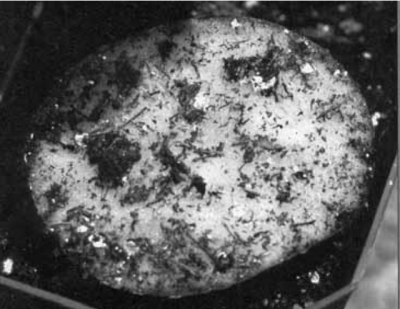
Yellow sticky cards, placed horizontally at the soil surface, can be used to detect fungus gnat adults. Check and change the cards weekly to detect early fungus gnat infestations. Use potato plugs (at least one inch in diameter) placed on the soil surface to monitor for fungus gnat larvae (Figures 5 and 6). When using potato plugs, place the plug so there is contact with the media to ensure that the potato plug does not dry out. To look for larvae, first check the growing media under the plug and then the surface of the potato itself. Check the potato plugs after 48 hours for the presence of larvae. Be sure to mark the locations where you placed the potato plugs, so you can easily find them! Remove potato chunks so they do not "melt out,” or sprout. For smaller cuttings or plugs, potato slices, resembling a “French fry” can be placed in the growing media.
Cultural Controls
Adults are attracted to newly planted crops. Dry, level, weed-free, well-drained greenhouse floors help eliminate breeding areas. Keeping cull piles away from the greenhouse and cleaning up any spilled media on the floor also helps eliminate breeding areas. Avoid overwatering and keep crops as dry as possible during production. Avoid having excess moisture and puddles underneath greenhouse benches. Remove plant debris, weeds, and old growing media from inside and outside the greenhouse.
Inspect incoming plugs for fungus gnat larvae or their feeding damage. Fungus gnats may be introduced into a greenhouse from soilless media or on rooted plant plugs.
Adults are attracted to mixes with high microbial activity, or with high amounts of peat moss, compost or composted hardwood bark. Avoid using mixes with immature composts less than one year old. However, no potting mix is immune to fungus gnat infestations. Adult females prefer to lay their eggs in protected, humid crevices in the media. How the media is handled and stored may be more important than the type of growing media used. If the growing media is stored outside and stays moist, it may support more fungus gnat activity. Tears or openings in the bags enable native fungus gnats to enter the media bags. Store the media so that it stays dry.
Covering the growing media with a layer of coarse sand or diatomaceous earth does not prevent egg laying by the adult females. Diatomaceous earth absorbs moisture from the growing media so cracks develop where larvae pupate, and females lay their eggs.
Biological Controls
Commercially available biological control agents (BCAs) include the soil dwelling predatory mite, Stratiolaelaps scimitus, the entomopathogenic nematode, Steinernema feltiae, and the rove beetle, Dalotia coriara. All should be used preventively and applied to moist growing media. See Biological Control of Fungus Gnats under publications and then biological controls on the UConn Greenhouse IPM website for more information.
Steinernema feltiae are beneficial, insect killing nematodes that are applied as a drench treatment against fungus gnat larvae. After entering the target insect through various openings, the nematodes multiply within the host and release a bacterium whose toxin kills the larvae. These beneficial nematodes reproduce within the fungus gnat larvae; exit the dead body and search for new hosts to infect. Fungus gnat larvae are killed in one to two days. (See Beneficial Nematodes: An Easy Way to Begin Using Biological Control in the Greenhouse, under publications and then Biological Controls on the Greenhouse IPM website for specific application tips).
A small, soil-dwelling predatory mite, Stratiolaelaps scimitus, feeds on fungus gnat larvae as well as thrips pupae and shore fly larvae. It is shipped in a vermiculite/peat carrier with all stages of the predatory mites. The vermiculite/peat carrier can be distributed over the media surface, especially when pots are placed close together. These predatory mites are best used when fungus gnat populations are low.
The rove beetle, Dalotia coriara, is a generalist predator that feeds upon fungus gnat and shore fly larvae in the growing media. Adults are slender, dark brown or black with very short wing covers. Adults are nocturnal so are best released in the evening. Both adults and larvae tend to hide in cracks and crevices of the growing media.
Bacillus thuringiensis var. israelensis, sold under the trade name of Gnatrol WDG, is most effective against the young first instar larvae. The bacteria must be ingested by the larvae, after which a toxic protein crystal is released into the insect's gut. Larvae stop feeding and die. Gnatrol WDG is only toxic to larvae for two days. Repeat applications,
i.e. two or three applications at high rates, may be needed to provide effective control on greenhouse ornamentals and vegetables.
Chemical Controls
Insect growth regulators, microbials, and other pest control materials may be applied to the growing media to manage fungus gnat larvae. Repeat applications may be needed. For more see, the New York and New England Management Guidelines for Greenhouse Floriculture and Herbaceous Ornamentals.
Disclaimer for Fact Sheets: The information in this document is for educational purposes only. The recommendations contained are based on the best available knowledge at the time of publication. Any reference to commercial products, trade or brand names is for information only, and no endorsement or approval is intended. UConn Extension does not guarantee or warrant the standard of any product referenced or imply approval of the product to the exclusion of others which also may be available. The University of Connecticut, UConn Extension, College of Agriculture, Health and Natural Resources is an equal opportunity program provider and employer.