The two-spotted mite (TSSM), Tetranychus urticae, is the predominant mite species in greenhouses, feeding on many different herbs, herbaceous perennials, spring annual bedding plants, and greenhouse vegetables. This mite is difficult to control because of its short generation time, potential for rapid increase and development of resistance to many commonly used miticides. Growers often overlook spider mites, due to their small size and tendency to feed on the underside of leaves, until outbreaks occur. The target audience of this fact sheet is commercial greenhouse growers.
Identification
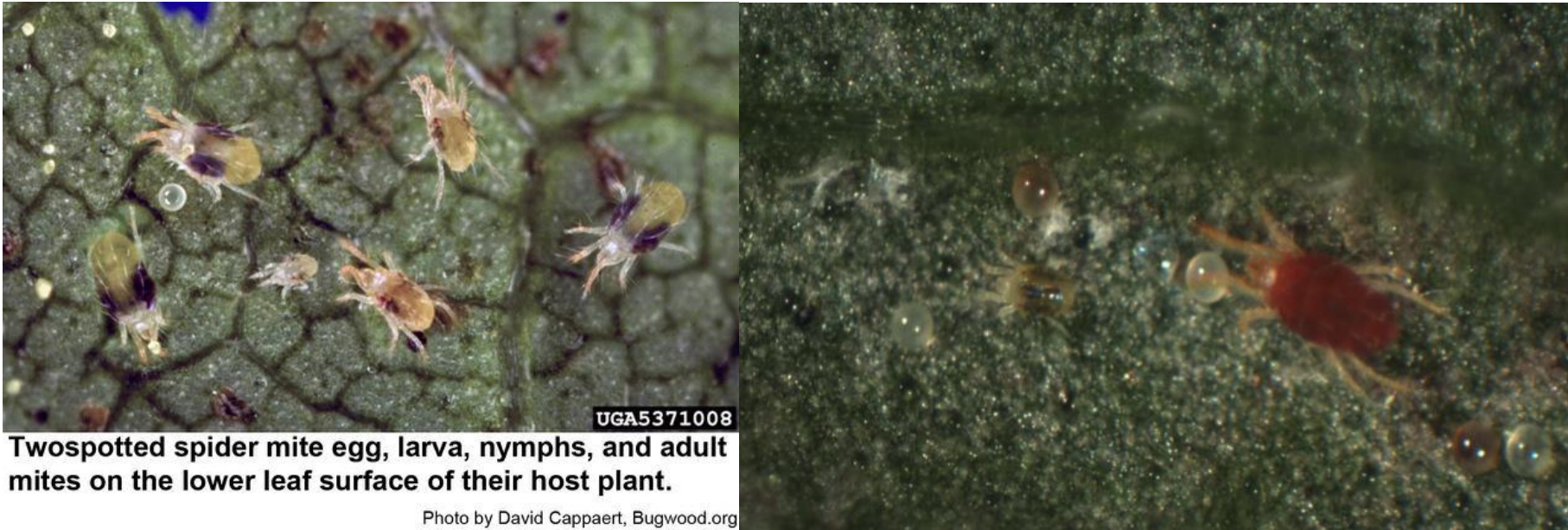
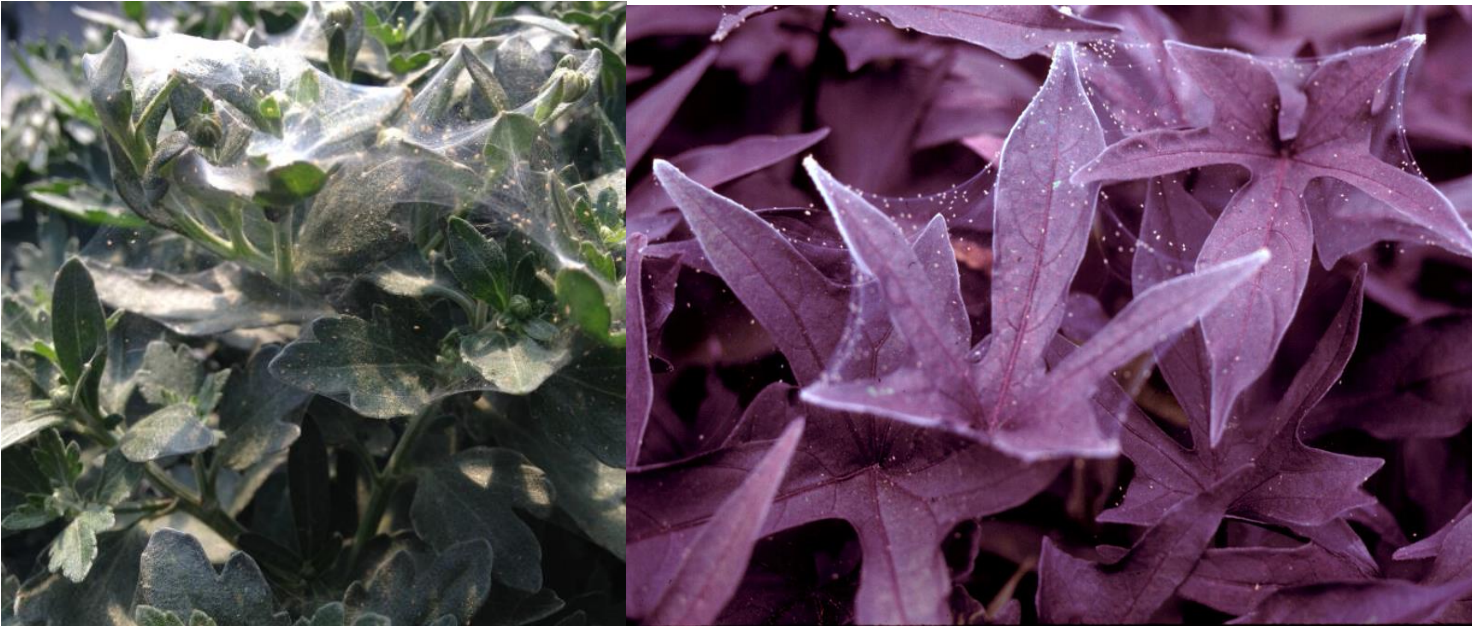
Spider mites are more closely related to spiders and ticks than insects. They have eight legs rather than six legs and only two body regions (the head and thorax are fused together). Adult females are small, (less than 1/50 of an inch long), soft-bodied and oval in shape. Color varies from greenish or yellowish to orange with two dark spots on either side of their body. Bright orange forms occur when adult females are overwintering (diapausing). Spider mites have a pair of silk glands near their mouthparts enabling them to spin webbing or silk threads.
Feeding Damage
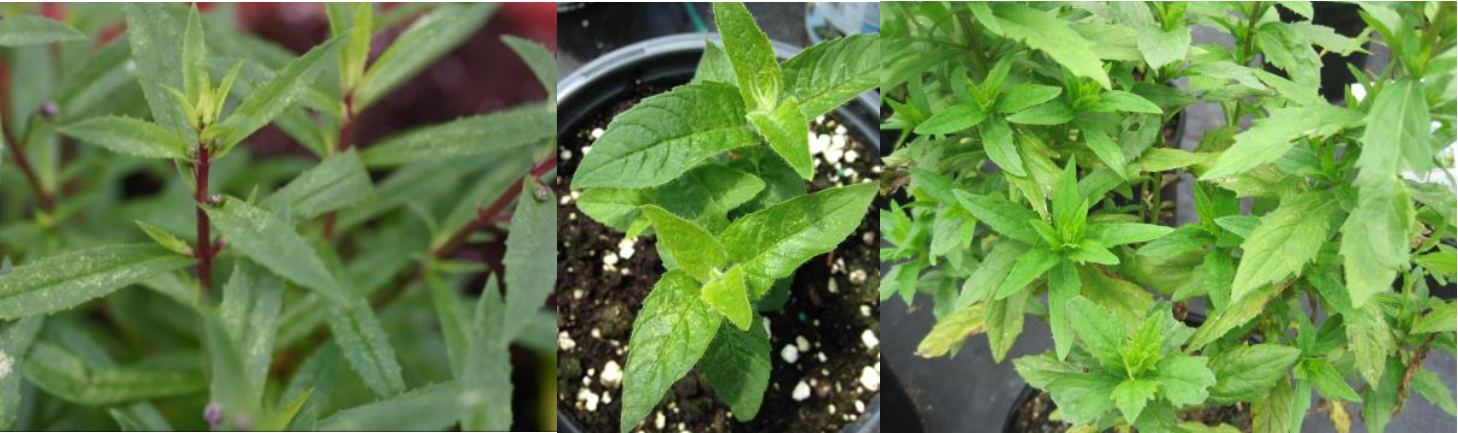
As spider mites insert their needle-like mouthparts into plant tissue, they suck out plant juices reducing chlorophyll and moisture content within the leaf cells. At first, you will see a slight whitish or yellowish flecking or stippling (chlorotic spot) on the leaves. As mite feeding continues, leaves can turn yellow or bronzed, and may drop from the plant.
Biology and Life Cycle
Adult females can live for about one month and lay approximately 100 eggs, which are small, spherical in shape and are laid singly on the underside of leaves. Eggs hatch in about three days and the young mite larvae immediately begin feeding. After going through two nymphal stages, spider mites become adults. Adult females begin laying eggs within 1 to 3 days and do not have to mate to reproduce.
The life cycle from egg to adult varies from 7 to 21 days depending upon greenhouse temperatures. Spider mite populations increase most rapidly during warm, dry conditions, when temperatures are between 68° F and 86˚ F and relative humidity is 30 to 50%.
Prevention
- Inspect incoming plants for signs of spider mites and their damage.
- Avoid over fertilizing plants. Spider mites are more able to feed upon lush, succulent growth. Increased fertility levels, especially nitrogen, provide amino acids that are needed for the spider mites to develop.
- Eliminate weeds in and around greenhouses that can harbor spider mites.
- Promptly remove unsold or “pet plants” as older plants may be a source of mites for younger plants.
- Avoid allowing plants to become water-stressed, as those plants have higher levels of amino acids, which are favorable to spider mites.
- Overhead watering helps wash spider mites off plants and increases relative humidity in the plant canopy.
Scouting
- Inspect plants weekly for signs of spider mite feeding as well as eggs, larvae, adults and webbing.
- Plant inspection is needed to detect all stages of mites. First, look for slight discoloration or flecking. Then, turn over leaves, especially the older, more mature leaves and look for the spider mites that tend to be found along the leaf veins. Use a 10-20x hand lens to detect the eggs and all stages of mites. Look on the underside of the leaves for cast skins and empty eggshells, too.
- In the greenhouse, focus on scouting hot and dry locations near furnaces.
- Check near the doorways and vents, where mites may be blown in from weedy areas outside.
- Tag pest infested plants as indicator plants to determine the effectiveness of control measures.
- Because mites are easily carried on workers or their clothing, do routine greenhouse tasks and scout in mite-infested areas at the end of the day.
Two-spotted spider mites can feed on over 300 different species of plants. Many greenhouse ornamentals are favored hosts including dracaena spikes, ivy geraniums, New Guinea impatiens, garden impatiens, hydrangea, marigolds, pansy, sweet potato vine, vinca vine, and verbena. Many herbaceous perennials including beebalm, hollyhock, columbine, daylily, butterfly bush, primula, scabiosa, verbena, and salvia are also prone to spider mites. Herbs such as lemon balm, lemon verbena, lemon grass, oregano and mints can also be favored hosts.
Biological Control
Several different predatory mites are commercially available. See Biological Control of Two-Spotted Spider Mites factsheet on the UConn Greenhouse IPM webpage for more information.
Chemical Control
Contact or translaminar miticides may be used. When treating with contact materials, thorough coverage is needed to cover the underside of the leaves where the spider mites are feeding. Resting stages and eggs can be more tolerant of many miticides so repeated applications are often needed.
Spider mites develop resistance to miticides very rapidly. The miticides used in a rotation schedule should have different modes of actions (i.e. come from different pesticide classes and work differently). Follow long-term rotations and all label restrictions in terms of amount and frequency of use. Many of the newer miticides are more selective toward a specific life stage or are more effective when populations are low. See New York and New England Management Guidelines for Greenhouse Floriculture and Herbaceous Ornamentals for more information.
Disclaimer for Fact Sheets: The information in this document is for educational purposes only. The recommendations contained are based on the best available knowledge at the time of publication. Any reference to commercial products, trade or brand names is for information only, and no endorsement or approval is intended. UConn Extension does not guarantee or warrant the standard of any product referenced or imply approval of the product to the exclusion of others which also may be available. The University of Connecticut, UConn Extension, College of Agriculture, Health and Natural Resources is an equal opportunity program provider and employer.