Introduction
Mealybugs are one of the most difficult greenhouse pests to control. Their wide host range, high reproductive potential, tendency to hide in protected locations, their ease of spread on workers, tools and plants, ability to survive on greenhouse benches, in cracks and crevices without live plant material for two weeks, all make them challenging to eradicate. Mealybugs may be introduced into greenhouses on infested tropical, foliage and succulent plant shipments. In greenhouses, where mealybug susceptible plants are carried over from season to season, management is an ongoing challenge. The target audience of this fact sheet is commercial greenhouse growers.
Feeding Damage
With their piercing-sucking mouthparts, mealybugs feed on plant sap, residing in leaf and stem axils. As they feed, both nymphs (“crawlers”) and adults cause plant stunting, leaf yellowing and distortion as they inject toxic saliva into plant tissue. Mealybugs excrete sticky honeydew that serves as a growing media for black sooty mold fungi. If high enough populations develop, plants can become unsaleable and even killed.
Biology and Life Cycle
Mealybugs are soft-bodied, segmented oval-shaped insects. Adult females are about 1/20 to 1/5 of an inch long covered with white, powdery, waxy secretions. Their typical life cycle consists of an egg stage (except for the longtailed mealybug that gives birth to live young), immature nymphal stages ("crawlers") and adult. The immature crawlers mature in about 6 to 9 weeks. Crawlers can disperse thoroughout the greenhouse as workers handle plants, via air currents, and as ants move the crawlers among plants. Mature females die after egg laying. The short-lived adult males are small, winged
insects that do not feed. In the greenhouse, continuous and overlapping generations make control difficult.
Scouting
Early detection is difficult but needed to avoid outbreaks. As only the short-lived winged males fly, do not rely on yellow sticky cards to detect mealybugs. Early infestations can be easily overlooked due to the mealybug's tendency to hide in protected locations. Look for white flecks or cottony residues along the leaf midribs, on leaf or stem axils, stem tips and on the underside of leaves and near the base of plants. If larger plants are staked, mealybugs can hide beneath the tape on the stake that is used to secure the plant. Adult females may crawl off plants and be found in brick crevices and under
benches where they lay eggs.
Honeydew, sooty mold, and the presence of ants may also be an indication of a mealybug infestation. Focus on scouting mealybug-prone plants such as begonia, citrus, coleus, croton, dracaena, hoya, English ivy, ficus, fuchsia, stephanotis,
schefflera, hibiscus, mandevilla, strawberry plant (houseplant), jade plants, palms, poinsettia, prayer plants, gardenia, orchids, tropical and succulent plants.
The Mexican mealybug has been found feeding on marigolds, gerbera daisies, poinsettias, begonias, and chrysanthemums.
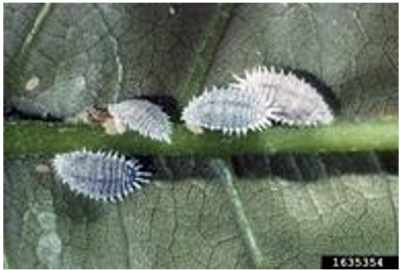
Citrus mealybug and longtailed mealybugs are two of the more common species found in Connecticut. In 2016, the obscure mealybug was reported from a Connecticut retail nursery. Some mealybug species (Rhizocoeus spp. and Phenococcus spp.) feed on plant roots. Madeira mealybugs, pink hibiscus mealybugs, and miscanthus mealybugs may also occur. Identification to species is needed when using host specific biological controls.
Citrus mealybugs (Planococcus citri)
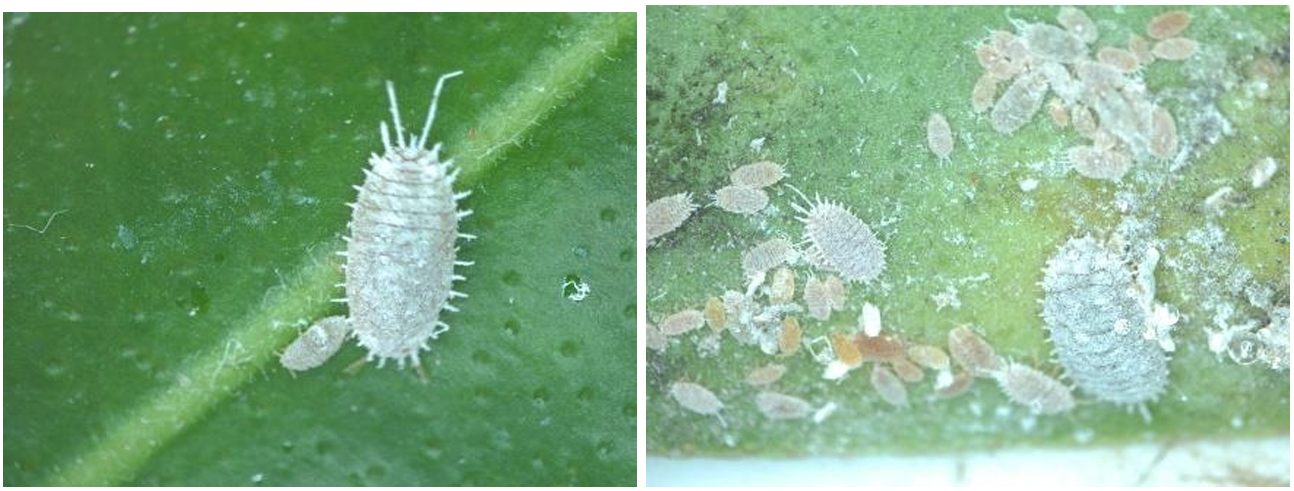
Females are small (less than 1/8 of an inch long), mealybugs with a faint purplish stripe running down their back. They also have short waxy filaments around the margin of their oval body with a slightly longer pair of filaments at their rear. Citrus mealybugs do not have tail filaments. Females produce a cotton-like egg sac containing yellow eggs and lay from 300 to 600 eggs. Eggs hatch into small, active crawlers. When the crawlers settle down to feed, they begin to secrete
wax and produce honeydew. Males resemble females from the egg stage to the third instar nymphal stage. After pupating, the winged adult male emerges but only lives for 1 or 2 days and does not feed.
Longtailed mealybugs (Pseudococcus longispinus)
Have distinctive long tails (about ¾ or more of their body length) hence their common name. Longtailed mealybugs produce live young and do not have to mate to reproduce.
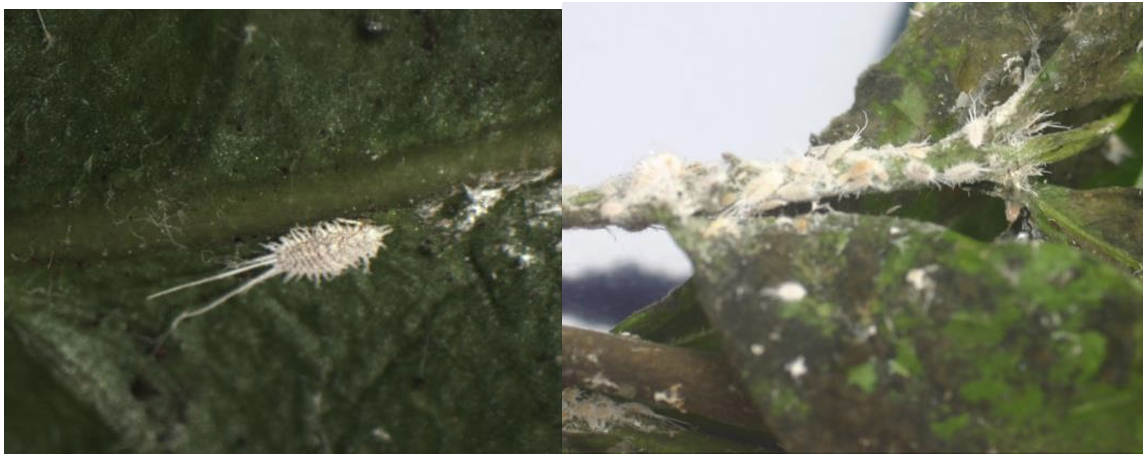
Obscure mealybugs (Pseudococcus viburni)
Looks like citrus mealybugs but lack the faint grey strip running down their back. They also have longer tailed filaments and a thicker coating of wax than the citrus mealybug.
Cultural Controls
Once mealybugs become established, it is difficult to achieve effective control. Adult females can live for up to 19 days without a host plant and crawlers can continue to emerge for up to 45 days.
- Inspect incoming plants for signs of mealybugs.
- Keep plants well-watered and do not overfeed them. High nitrogen fertility favors mealybug reproduction.
- Closely monitor mealybug-prone plants.
- Do not hold over "pet plants" that may be infested.
- Keep greenhouses as weed-free as possible.
- A forceful jet of high-pressure water twice a week may help remove mealybug eggs, crawlers, and adults.
- Power wash and sanitize greenhouse benches between crops.
- Do not reuse contaminated pots.
- Bait and control ants that can move crawlers around and disrupt biological controls.
- Immediately destroy heavily infested plants.
Biological Controls
Both adults and larvae of the mealybug destroyer (Cryptolaemus montrouzieri) feed upon mealybugs that lay eggs. Green lacewings (Chrysoperla sp.) better known as aphid predators, can also feed upon mealybugs. For more see Biological Control of Mealybugs fact sheet on the UConn Greenhouse IPM website.
Chemical controls
Mealybugs are best treated if detected early when populations are low. If only a few plants are heavily infested, it is best to destroy the infested plants to minimize further spread. Nymphs are the most susceptible life stage because they haven’t yet formed a waxy covering. Use of a spreader sticker may help penetrate the or a mealybug's waxy covering.
Control is also difficult because of the mealybug’s tendency to hide in protected locations and form dense colonies. Overlapping generations often occur so all life stages are present (eggs, crawlers, and adults.). Most insecticides also have limited activity against mealybug eggs. So, repeated applications are needed to target the more susceptible mealybug nymphs.
Contact insecticides such as insect growth regulators, insecticidal soap and horticultural oil will kill young nymphs (provided there is good coverage); however, as eggs hatch through the growing season, additional applications are needed. Two to three weekly applications of insecticides are often needed to suppress mealybugs when there are overlapping generations. Through coverage is necessary when using contact insecticides. Use a forceful jet of water to dislodge the older instars and then apply the contact materials, such as oils or soaps. Read labels carefully for resistance management guidelines. Research by Herrick et al. 2018, reported less than 50% mortality when using systemic insecticides against citrus mealybugs, whether products were applied preventively or curatively. They concluded that greenhouse producers
would have to resort to contact insecticides against citrus mealybugs. See the New York and New England Management Guidelines for Greenhouse Floriculture and Herbaceous Ornamentals.
Descargo de responsabilidad para las hojas informativas: La información de este documento es solo para fines educativos. Las recomendaciones contenidas se basan en el mejor conocimiento disponible en el momento de la publicación. Cualquier referencia a productos comerciales, nombres comerciales o de marca es solo para información y no se pretende ningún respaldo o aprobación. La Extensión de UConn no garantiza el estándar de ningún producto al que se hace referencia ni implica la aprobación del producto con exclusión de otros que también puedan estar disponibles. La Universidad de Connecticut, Extensión de UConn, Facultad de Agricultura, Salud y Recursos Naturales es un empleador y proveedor de programas con igualdad de oportunidades.