Introduction
One of the most important and difficult-to-control thrips species is the western flower thrips (WFT), Frankliniella occidentalis. It is also the dominant species found in commercial greenhouses in New England.
More than one dozen species of thrips feed on greenhouse-grown crops including the onion thrips (Thrips tabaci), the leaf feeding poinsettia thrips (Echinothrips americanus) and Thrips parvispinus, whose feeding damage may be confused with broad mites. See Simple key to important thrips pests of Canadian greenhouses listed in the references for more information on how to identify thrips species.
Western flower thrips have spread throughout the horticulture industry on plugs, and cuttings. Their small size (1/16 inch) and tendency to remain hidden in flower buds makes it difficult to detect the thrips before severe feeding damage is evident. WFT broad host range, high reproductive capacity, rapid life cycle, and resistance to insecticides make them difficult to control. The target audience of this fact sheet is commercial greenhouse growers.
Feeding Damage
Thrips feed by piercing plant cells with their mouthparts and feeding on the exuded plant juices. This collapse of plant cells results in deformed flowers, leaves, and shoots. Silvery-flecked scars and small black "fecal" spots may be seen on the expanded leaves.
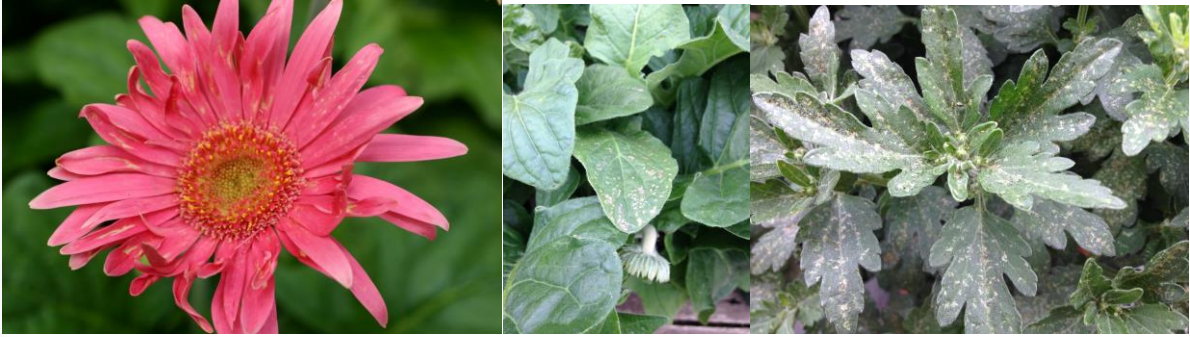
Western flower thrips have a broad host range and may feed upon greenhouse ornamentals, vegetables, herbs, and herbaceous perennials. Some favorite hosts include Ageratum, alyssum, basil, bacopa, begonia, calibrachoa, calendula, celosia, chrysanthemum, dahlia, dianthus, dracaena spikes, eggplant, fuchsia, herbs (many especially tarragon), gazania, geraniums (ivy), gerbera daisy, Ipomoea, marigolds, New Guinea Impatiens, petunia, pepper, portulaca, primula, salvia, snapdragon, tomato, verbena, and zinnia. Alcea, Asclepias, Aster, Campanula, Centurea, Chrysanthemum, Coreopsis, Crocosmia, Digitalis, Echinacea, Eupatorium, Lamium, Lupinus, Malva, Monarda, Penstemon, Platycodon, Polemonium, Phlox, Rudbeckia, and Tanacetum are some of the herbaceous perennials that may be fed upon by western flower thrips.
In addition to direct feeding injury, WFT may vector (spread) two closely related tospoviruses; impatiens necrotic spot virus (INSV) and tomato spotted wilt virus (TSWV), to uninfected plants. The tospoviruses have one of the widest host ranges of any known virus. Over 1000 plant species are confirmed hosts. Almost all greenhouse crops with the exception of roses and poinsettias are susceptible. Some of the more generic symptoms of tospoviruses include leaf spots, necrotic areas, mottling and ringspots. As soon as tospoviruses are detected, rogueing of infected plant material must be combined with strict thrips management. See Some Virus Diseases of Greenhouse Crops on the UConn Greenhouse IPM website under publications and then diseases for more information.
Life Cycle of Western Flower Thrips
Their life cycle consists of eggs, two nymphal stages, two pupal stages and adults. Adult females may live for approximately 30 to 45 days, feeding primarily on pollen. Females insert their saw-like ovipositors into plant leaves to lay eggs. During their lifetime, female thrips lay from 150 to 300 eggs that hatch in about one week. The first two larval stages remain protected in the tender young growth. They resemble adults but are wingless. After the second instar larvae stops feeding, it drops to the growing media to pupate. Thrips may also pupate in open flowers. Adults may then emerge in about 6 days, depending upon temperature. Adults are weak flyers but are spread throughout the greenhouse on air currents.
The thrips life cycle is dependent upon temperature with development occurring between 50° F and 90˚ F. Thrips can survive cooler temperatures than 50˚ F, however, there is no development at that temperature. Their life cycle varies from seven to 14 days at fluctuating temperatures between 68 to 98˚ F that may be more common in the greenhouse environment (Table 1).
Table 1. Life Cycle of Western Flower Thrips (Robb, 1988)
| Stage | Approximate duration at temperatures between 68° and 98°F |
| Egg | 2-4 days |
| 1st instar (immature) | 1-2 days |
| 2nd instar | 2-4 days |
| Prepupal | 1-2 days |
| Pupal | 1-3 days |
| Adult | 30-35 days |
In the greenhouse, thrips occur year-round whenever temperatures are favorable for their development and host plants (including weeds) are available for food.
Prevention and cultural controls
- Inspect incoming plants or cuttings
- If possible, keep thrips-infected plants isolated in a separate area to avoid the spread of thrips
- A weed-free barrier of at least 10 feet around the greenhouse may help to discourage thrips entry. When outdoor weeds desiccate or when weedy areas are mowed, thrips may enter the greenhouse to search for new hosts.
- Dispose of plant debris in tightly sealed containers. Do not allow open garbage bins in the greenhouse, as thrips may disperse from the drying plant material unto the crop.
- Keep greenhouse free of weeds, “pet plants”, and growing media debris.
Mass Trapping
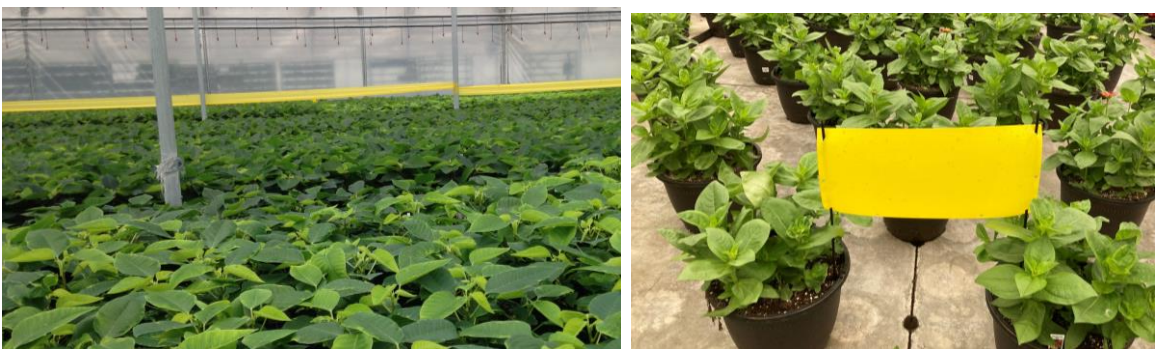
Mass trapping of thrips entering the greenhouses, especially during the summer months, can be done using “hopper tape” placed along the posts in gutter-connected greenhouses. Tape brackets or holders can be used to place the tape. Place the tape so it hangs a few inches above the crop. Larger sized cards than are traditionally used for yellow sticky card scouting can help mass trap out thrips. Canadian researchers used 8 larger sticky cards per 1000 ft2.
Scouting
- Early detection of western flower thrips is difficult due to WFT's high reproduction rate, rapid developmental time and tendency to hide in flowers and buds
- Use yellow sticky cards to monitor for the adult thrips. Use a 10-20x-hand lens to distinguish the adult thrips from grains of peat moss or other debris. Weekly counts of thrips adults on sticky cards helps determine population trends and the effectiveness of pest management tactics. Tolerance levels depend upon the crop, its stage of growth and the customer’s tolerance of pest damage. If plants become infected with tospoviruses, the tolerance level for thrips is zero and strict thrips control is then needed.
- Gently blowing into open flowers agitates the thrips so they are easier to see. Growers may also gently tap plant foliage or flowers over a sheet of white paper to dislodge thrips.
Biological Controls
Due to resistance to many different insecticides, more growers are using biological controls, especially during spring greenhouse production. Commercially available natural enemies include predatory mites Neoseiulus cucumeris, Amblyseius swirskii, predatory bugs (Orius species), rove beetles (Dalotia coriaria), insect- killing nematodes (Steinernema feltiae). See Biological Control of Western Flower Thrips on the UConn Greenhouse IPM website for more information. Entomopathogenic fungi may also be used against thrips.
Chemical Controls
Insecticides with contact or translaminar activity are generally used against thrips. Preventive drench applications may also be used. Resistance has been reported to organophosphates, carbamate, pyrethroid, and macrocyclic lactone chemical classes. To delay the onset of insecticide resistance, rotate between insecticides with different modes of action every two to three weeks, or after one generation (depending upon temperature). Repeated applications two to three times every 3 to 5 days (depending upon temperature) may be needed to reduce thrips numbers.
An integrated program focusing on prevention and cultural tactics and regular scouting is needed to manage western flower thrips.
Disclaimer for Fact Sheets:The information in this document is for educational purposes only. The recommendations contained are based on the best available knowledge at the time of publication. Any reference to commercial products, trade or brand names is for information only, and no endorsement or approval is intended. UConn Extension does not guarantee or warrant the standard of any product referenced or imply approval of the product to the exclusion of others which also may be available. The University of Connecticut, UConn Extension, College of Agriculture, Health and Natural Resources is an equal opportunity program provider and employer.