Nursery and Landscape Update
March 2020
By Victoria Wallace, Associate Extension Educator
Alyssa Siegel-Miles, Research Technician
Jacob Ricker, Nursery Technician
Pruning is an essential component of plant maintenance for professionals in both the landscape and nursery production sectors. While not all plants should be pruned in late winter/early spring, it is an ideal time for many woody plants, as long as pruning occurs before bud break. While physical removal of plant parts can be stressful for the plant, correct pruning will prevent undue stress and pose minimal harm. Strategic and judicious removal of branches at the proper locations on the plant can improve aesthetics and protect plant health.
PROPER PRUNING TECHNIQUES
Always use the appropriate tool for the job (Table 1). Using an unsuitable tool can potentially harm or stress the plant. For example, shears should be used to shape shrubs into hedges, not to cut larger branches. Using shears improperly can tear or rip stems. Pruners and saws more effectively ensure correctly placed, clean cuts that can heal properly and as quickly as possible.
Regularly sharpen tools. A sharp tool is more efficient and will produce a clean cut that will heal faster and better.
Refer to University of New Hampshire’s “Step-by-Step Instructions for Cleaning and Sharpening Your Pruners.”
| Tool | Appropriate Diameter of Stem/Branch |
| Hand pruner | up to 3/4 inch |
| Lopper | up to 1 1/2 inches |
| Hedge shear | for shearing hedges only |
| Hand saw | 1-4 inches |
| Chain saw | over 4 inches |
Table 1. Adapted from University of Minnesota Extension’s Pruning Trees and Shrubs
Always follow proper safety protocols. The potential for injury to the professional is always possible if appropriate precautions are not taken. Protect staff with properly fitting helmets, protective eyewear, and gloves as appropriate for the pruning task at hand.
Keep tools clean. When pruning diseased plants, use care to avoid spreading diseased material to uninfected plants. Remove contaminated branches and surrounding leaf litter. Sterilize tools with bleach or ethanol and safely dispose of affected plant material in garbage bags.
TYPES OF PRUNING CUTS
(adapted from Mary Concklin’s Stubs, Nubs and Bugs):
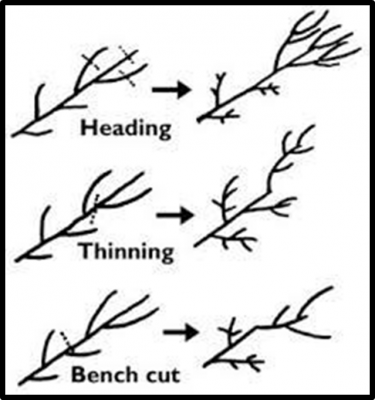
- A thinning cut (Figure 1) is the removal of a branch or lateral back to its point of When removing a branch back to the trunk, the cut should be flush to the branch collar, not flush to the tree. Thinning cuts open up the tree for improved light penetration and air flow, which will help to reduce many dis-eases (e.g., powdery mildew, brown rot).
- A heading cut is the removal of the tip of a branch to encourage lateral bud break, so that growth will be redirected to a side/lateral bud and break below the cut.
- A bench cut is the removal of the end of an upward growing branch to a downward or outward growing lateral. It is used on open center trees, such as peach. This type of cut may result in weak growth that has a greater chance of breaking under a heavy load of fruit.
| Goals of Pruning |
| 1. Remove dead wood, for the health of the plant and to reduce safety risks. |
| 2. Encourage flower and fruit development as well as healthy branching. Removing the apical (top) tip of the stem or branch stimulates growth of side buds and shoots. |
| 3. Eliminate crossing branches that may rub together and cause injury. |
| 4. Remove dying, injured, diseased, or insect pest infested branches. |
| 5. Improve plant appearance – maintain a dense hedge or shrub; remove unwanted branches, waterspouts, suckers, or undesirable fruiting structures that detract from plant appearance.. |
| 6. Rejuvenation or thinning of overcrowded or overgrown shrubs. |
PRUNING TIPS AND RULES OF THUMB
- Identify the purpose of each pruning job (Table 2).
- The amount of living plant material that can be removed at one time depends on the age and level of establishment of the plant (Table 3).
- Dead, broken, or diseased plant material can be pruned at any time of the year.
- Ensure that lateral branches are no more than 1/2 – 3/4 of the main stem or leader, to prevent the development of co-dominant stems.
- Selective pruning (one branch at a time), rather than shearing, is usually recommended. Shearing creates a formal, geometric shape that is incompatible with a natural landscape and becomes more difficult to maintain as the plant matures.
- Most evergreens need little to no pruning. Selective pruning may be effective to encourage dense, bushy growth, but will not effectively control Ensure correct plant selection; an overgrown evergreen should be replaced rather than attempting to prune it to a smaller size.
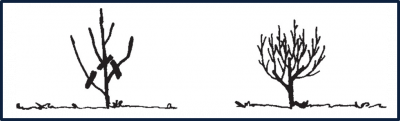
| Development Stage of Trees or Shrubs | Pruning Dose (maximum % of total foliage removed at one pruning) |
| Young, newly established
(Figure 2) |
50% |
| Medium-aged | 25% |
| Mature | 10% |
Table 3. Adapted from Purdue Extension’s Tree Pruning Essentials
- To rejuvenate multi-stemmed shrubs, remove one or more of the oldest stems at the base each year to stimulate new shoots to arise from the base of the plant. Many flowering shrubs bloom more prolifically on younger, 2 to 3-year-old wood. Shrubs that respond well to having some of the 3+ year-old stems removed include forsythia, weigela, deutzia, mock orange and beauty bush. Read more at Pruning Early Flowering Shrubs from UConn Extension or Proper Time to Prune Trees and Shrubs from Iowa State Extension.
- Newly established hedges should be pruned early in the growing season to promote the desired growth, and more established hedges may be kept vigorous and dense by thinning out older branches, which will en-courage new growth.
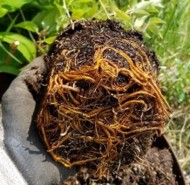
Figure 3. Root-bound container-grown plants may need to be pruned or loosened before planting. Photo by Alyssa Siegel-Miles.
Read more at:
Virginia Cooperative Extension: Guide to Successful Pruning: Pruning Deciduous Trees; Pruning Evergreen Trees
Morton Arboretum: Pruning Deciduous Shrubs; Pruning Evergreens
Colorado State University Extension: Pruning Evergreens
ROOT PRUNING
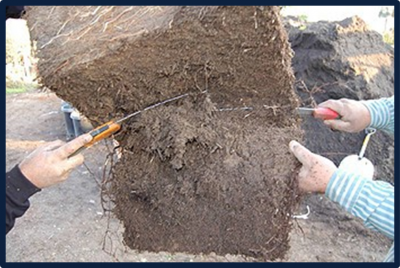
When rejuvenating landscapes or installing new plant material, including trees, it is critical to check plants, especially roots, to en sure plant health. When planting container-grown plants, root pruning may promote healthy root development. Corrective pruning of girdled roots (Figure 3) can protect the plant’s long term health. Girdled roots grow under or around the roots of the plant and can potentially harm or kill the plant if left unchecked. Remove the burlap or container of woody shrubs and check for girdled roots before planting. For large root-bound plants (Figure 4), removal of one inch of outer roots and media has been shown to improve root growth and transplant success (University of Florida). Clean tools before root pruning to prevent spread of pathogens and ensure proper irrigation of root-pruned plants. Established landscape trees can also be inspected for girdled roots by pulling away mulch layers and inspecting the roots that are visible at the soil surface (Figure 5).
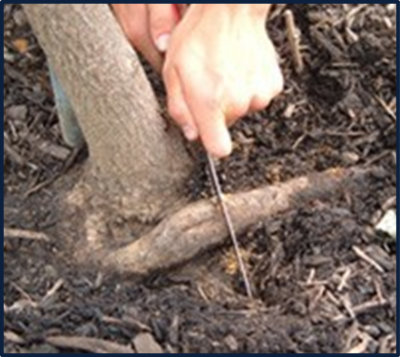
If root pruning is repeatedly required in nursery production, a larger container size may be considered to encourage healthy root growth and prevent girdling. Fabric pots or air-pruning containers or trays are options that encourage vigorous root growth while requiring less mechanical pruning.
TREE AND SHRUB PRUNING TIMING
Adapted from UConn Extension, Virginia Tech Extension, U. Minnesota Extension, Iowa State Extension, Purdue Extension, U. of Georgia Extension The proper time to prune woody plants is determined by the plant’s growth habit, bloom time, and health or condition. Avoid pruning woody plants during the fall or early winter, which may encourage tender new growth that is not sufficiently hardened before the onset of the winter season. Ornamental plants grown for foliage, rather than flowers, can be pruned in late winter-early spring or summer. Most evergreens should be pruned before new growth starts in the spring or during the semi-dormant period in mid-summer (except pines). Refer to Pruning Evergreens from University of Wisconsin for more information on how to prune specific evergreens.
Trees and Shrubs to Prune in Late Winter-Early Spring
These species should be pruned in late winter or early spring before growth begins. Most of these woodies bloom during fall and summer, on new wood (growth from the current season).
| Buddleia davidii, butterfly-bush |
| Callicarpa spp., beautyberry |
| Clethra alnifolia, summersweet |
| Cotinus coggygria, smokebush |
| Hamamelis virginiana, witch-hazel |
| Hydrangea arborescens, smooth hydrangea |
| Hydrangea paniculata, panicle hydrangea |
| Ilex verticillata, winterberry |
| Morella pensylvanica, bayberry |
| Oxydendrum arboreum, sourwood |
| Potentilla fruticosa, shrubby cinquefoil |
| Rhus spp., sumac |
| Spiraea spp., late blooming varieties |
| Swida racemosa, gray dogwood |
| Swida sericea, red-osier dogwood |
| Tilia spp., linden |
| Vaccinium corymbosum, blueberry |
Trees and Shrubs to Prune in Summer – After Flowering
Trees and shrubs that bloom in early spring, on old wood (growth from the previous season), must be pruned after flowering to avoid removing the current season’s flower buds.
| Amelanchier spp., serviceberry |
| Aronia spp., chokeberry |
| Calycanthus spp., sweetshrub |
| Cercis canadensis, redbud |
| Chaenomeles speciosa, flowering quince |
| Crataegus spp., hawthorn |
| Deutzia gracilis, deutzia |
| Forsythia spp., forsythia |
| Fothergilla gardenii, fothergilla |
| Hydrangea macrophylla, bigleaf hydrangea |
| Hydrangea quercifolia, oakleaf hydrangea |
| Kolkwitzia spp., beautybush |
| Magnolia spp., magnolia |
| Malus spp., crabapple |
| Prunus virginiana, chokecherry |
| Prunus spp., flowering cherry |
| Prunus × cistena, purpleleaf sandcherry |
| Pieris japonica, Japanese pieris |
| Rosa spp., climbing roses |
| Rhododendron spp., Azalea |
| Syringa vulgaris, lilac |
| Spiraea spp., early blooming varieties |
| Viburnum spp., viburnum |
| Weigela spp., weigela |
This work is supported by the Crop Protection and Pest Management Program [grant no. 2017-70006-27201/project accession no. 1013777] from the USDA National Institute of Food and Agriculture. Any opinions, findings, conclusions, or recommendations expressed in this publication are those of the author(s) and do not necessarily reflect the view of the U.S. Department of Agriculture.
UConn is an equal opportunity program provider and employer. © UConn Extension. All rights reserved.