and Landscape Management
Nursery and Landscape Update February 2020
By Jacob Ricker, Nursery Technician
Alyssa Siegel-Miles, Research Technician
Victoria Wallace, Associate Extension Educator
Biological pest control (Biocontrol) is an IPM practice that uses living organisms to control and reduce populations of undesirable pests. These organisms may be bacteria, fungi, or predatory or parasitic agents (e.g., insects, mites, nematodes). Biocontrol has been used widely in greenhouse production and is an expanding component of nursery and landscape IPM to control insect pests, diseases, and invasive plants. Proper implementation and maintenance of beneficial organisms (also known as natural enemies) are key to achieving control of pests. Successful use of existing biocontrol products and strategies is variable, with greater efficacy currently achieved within certain target pest groups.
BIOLOGICAL PEST CONTROL FOR LANDSCAPES
Biocontrol can be used in landscapes to control insect pests, diseases, and invasive plants. In an outdoor environment, attracting and conserving predators may be the most effective and economical means to control pests. While beneficial predators can also be purchased and released, an outdoor environment may pose challenges. Viability of released biologicals can be affected by inconsistent humidity and high wind conditions in out-door environments.
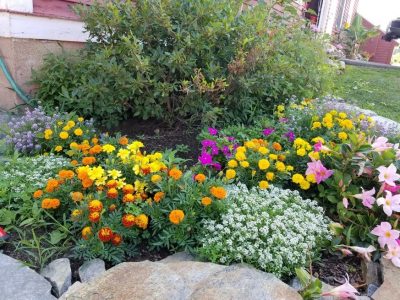
Planting annuals and native perennials that attract beneficial predators is a viable method to maintain populations of beneficial insects in outdoor landscapes. Naturally occurring beneficial predators found in many landscapes include lacewings, hoverflies, ladybugs, praying mantis, parasitic wasps, spiders, assassin bugs, and soldier beetles.
Many beneficial insects rely on plants as a food source (nectar and pollen) or for shelter. Many natural enemies are omnivores, requiring nectar and pollen as well as insects in their diet. Flowering plants and “banker plants” (Figure 1) may provide alternative food sources for omnivorous beneficial insects to support populations when insect pests are limited.
To attract beneficial predators and pollinators, landscape biodiversity, with the inclusion of habitat and banker plants, is critical. Landscapes with a diverse selection of plant species that incorporate a variety of flowering plants, with an emphasis on native trees, shrubs, and perennials of varying sizes are less likely to have major pest problems than homogeneous landscapes.
Plants that support biological garden health
ANNUALS
Common Name, Botanical Name
Sweet alyssum, Lobularia maritima
Cosmos, Cosmos bipinnatus
Marigold (yellow forms), Tagetes spp.
Calendula, Calendula officinalis
Sunflower, Helianthus annuus
Zinnia, Zinnia elegans
Dill, Anethum graveolens
Fennel, Foeniculum vulgare
Cilantro, Coriandrum sativum
Mint, Mentha spp.
PERENNIALS
Common Name, Botanical Name
Common yarrow, Achillea millefolium
Wild bergamot, Monarda fistulosa
New England aster, Symphyotrichum novae-angliae
Goldenrods, Solidago spp.
Joe-pye weed, Eutrochium spp.
Foxglove beardtongue, Penstemon digitalis
Culver’s root, Veronicastrum virginicum
Helen’s flower, Helenium autumnale
Anise hyssop, Agastache foeniculum
Butterfly weed, Asclepias tuberosa
BEST MANAGEMENT PRACTICES TO ATTRACT BENEFICIAL INSECTS INCLUDE:
- Increase planting of native species: typical landscapes consist of only 10-30% natives. Where possible, add native plants into established landscapes. Incorporate a variety of flower shapes and sizes.
- Diversify and extend bloom times: include early and late bloomers from May to October and both herbaceous perennials and native species.
- Utilize a range of colors: purples, blues, yellows and whites attract bees (Figure 2). Reds and oranges attract butterflies and hummingbirds.
- Avoid cultivars that have been bred as double flowers: they are typically sterile, or it may be difficult for pollinators to access floral re-sources from modified flowers.
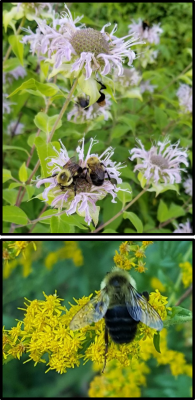
Figure 2. Many pollinators, like these bumblebees, are supported by bergamot (top) and goldenrod (bottom). Photos by Alyssa Siegel-Miles.
BIOLOGICAL PEST CONTROL IN NURSERY PRODUCTION
Introduction of biological control agents (Figure 3) into a nursery production system should be done properly to ensure desired management of pests. The methods outlined below are widely used in greenhouse nursery production and may also be used or adapted in outdoor nursery spaces. The two commonly practiced strategies for the release of natural enemies into nursery production systems are inundative and inoculative releases.
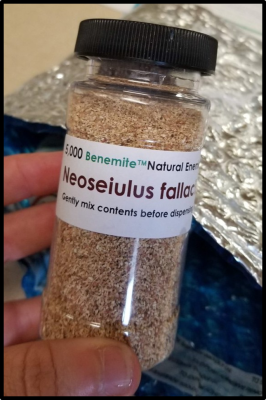
During inundative releases, large quantities of biological control agents are released, multiple times throughout a growing season, in areas of the nursery that contain pests. This strategy of repeated release attempts to overwhelm populations of the pest by consistently introducing natural enemies that control their populations. For example, lacewing larvae or eggs may be released bi-weekly on established containerized herbaceous perennials during the growing season. Growers can improve lacewing mobility by releasing them where plant vegetation overlaps or touches and on plants that have little standing moisture on leaf surfaces.
The inoculative release method introduces biological controls during the start of a season in locations where a known pest is expected to predominate. The release of strategic natural enemies that predate or parasitize pests can provide control of pests as they develop during the growing season. For example, predatory mite species may be released during the spring growing season to inoculate plants that typically receive pressure from two-spotted spider mites. To support beneficial predatory mites, allow easier access to prey by releasing them in areas with dense vegetation and short plants (Pratt et al., 2002).
Release of biological control agents is easier when plants are small and placed pot-tight in production or during propagation. Many biologicals require specific environmental conditions, such as sufficient humidity. It is important to maintain suitable environmental conditions for the selected beneficials in order to promote their longevity (Williams et al., 2004).
Chemical usage
Pesticide usage may have a negative impact on biological control agents and impede their establishment. Spraying insecticides or miticides with long residual periods will create an unsuitable environment for natural enemies, but there are some compatible products available. For example, applications of Acetamiprid, Bacillus spp., Beauveria spp., and Bifenzate, are safer options for treating pests that have a minimal impact on the survival of beneficial insects and biological control agents (Davidson and Raupp, 2014; Betheke, 2019; Pundt, 2019b).
Banker Plants
Banker plants can be used effectively in nursery production as well as in the landscape. In nursery production systems, banker plants are non-crops that support bio logical control agents by providing alternative resources for reproduction or food, allowing growers to preserve natural enemy populations (Figure 4). Horticultural oils may be used before natural enemies are released, but not during the implementation of a biological control program.
Many banker plant systems work well when banker plants are inoculated with natural enemies before the start of crop production. However, for the release of predatory mites, banker plants need only a few days to get established with populations of biological control agents.
| Pest | Banker Plant | Food Source | Natural |
| Aphids | Wheat | Rhopalosiphum padi | Aphidius colemani |
| Thrips | Ornamental pepper ‘Masquerade’ and ‘Red Missile’ | Pollen | Predatory mites |
| Spider mites | Mullein, ornamental pepper ‘Purple Flash’ and ‘Black Pearl’ | Pollen | Orius insidiosus |
| Whitefly | Mullein | Plant sap | Dicyphus hesperus |
Figure 4. Adapted from MSU and Nursery Magazine
Sources
- Bethke, J “How to Manage Pests.” UC IPM Online, UC IPM Pest Management Guidelines: Floriculture and Ornamental Nurseries, May 2019.
- Davidson, John , and Michael J. Raupp. Managing Insects and Mites on Woody Plants: An IPM Approach. Tree Care Industry Association, 2009.
- Pundt, “Starting a Biological Control Program for Greenhouse Insect and Mite Pests” UConn Fact Sheet (2019a).
- Pundt, “Some Factors Concerning Pesticide Compatibility with Biological Control Agents.” UConn Fact Sheet (2019b).
- Pratt, D., Robin Rosetta, and B. A. Croft. “Plant-related factors influence the effectiveness of Neoseiulus fallacis (Acari: Phytoseiidae), a biological control agent of spider mites on landscape ornamental plants.” Journal of Economic Entomology 95.6 (2002): 1135-1141.
- Williams, Michael De Courcy, et al. “Phytoseiid mites in protected crops: the effect of humidity and food availability on egg hatch and adult life span of Iphiseius degenerans, Neoseiulus cucumeris, N. californicus and Phytoseiulus persimilis (Acari: Phytoseiidae).” Experimental & applied acarology 32.1-2 (2004): 1.
Always read and follow label instructions. The information in this document is for educational purposes only. The recommendations contained are based on the best available knowledge at the time of publication. Any reference to commercial products, trade or brand names is for information only, and no endorsement or approval is intended. The Cooperative Extension System does not guarantee or warrant the standard of any product referenced or imply approval of the product to the exclusion of others which also may be available.
This work is supported by the Crop Protection and Pest Management Program [grant no. 2017-70006-27201/project accession no. 1013777] from the USDA National Institute of Food and Agriculture. Any opinions, findings, conclusions, or recommendations expressed in this publication are those of the author(s) and do not necessarily reflect the view of the U.S. Department of Agriculture.
UConn is an equal opportunity program provider and employer. © UConn Extension. All rights reserved.