and Plant Identification Guide
Authors:
Alyssa Siegel-Miles, Victoria Wallace, and Sara Tomis
UConn Extension
Download a PDF version of this article
Interest in pollinator health has grown exponentially over the last decade. Pollinator species have declined in population due to multiple factors – most importantly, the loss of their natural habitats and lack of forage opportunities.
Home gardeners and green industry professionals can improve pollinator health by increasing the amount and diversity of native plants in managed landscapes. The restoration and improved health of our Connecticut ecosystems will support a more diverse variety of beneficial insect and other animal species.
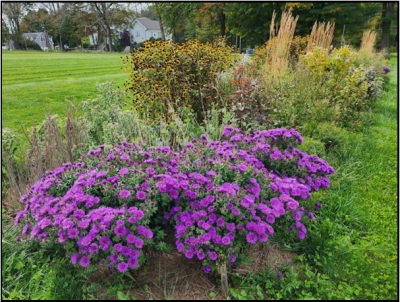
Meadows are a viable option to support pollinator health by expanding the use of native plants within the landscape. A meadow is composed of grasses and native wildflowers, becoming aesthetically pleasing, functional, and self-sustaining over time. Native meadow plants are resilient, have adapted to the regional climate, and can survive adverse conditions. Meadows that are incorporated successfully into property management programs reduce maintenance expenses over time. While the first year of management requires attention and effort, the installation of a meadow can reduce labor and energy inputs associated with repeated mowing of expansive turfgrass areas, as well as challenging maintenance of slopes and uneven terrain.
In 2022, a demonstration meadow project was initiated at the Plant Science and Landscape Architecture Research Facility in Storrs, CT to serve as an educational resource and to evaluate meadow establishment practices, planting methods, and weed management strategies. This guide was developed to support the identification of pollinator meadow plants from germination to maturity. Seedling identification can help distinguish weeds that germinate in the seedbed from the desired meadow plants.
Listed are descriptions and photographs of plant species selected for the meadow demonstration project. Identification characteristics are described for the young seedling stage where there is significant difference from the mature plant.
All plants are (unless otherwise noted):
- Native to northeastern U.S.
- Perennial, and will generally bloom in the SECOND year, when grown from seed.
- Hardy in the state of CT (USDA zones 5b to 7a).
See UConn’s Native Plant and Sustainable Landscaping Guide for additional species to include in a meadow.
Connecticut Native Meadow Seedling Identification Chart
| Leaf Arrangement | Simple or Compound | Leaf Characteristics | Botanical Name | Common Name |
| Alternate | Simple | Narrow; pointed | Asclepias tuberosa | butterfly weed |
| Alternate | Compound (pinnate – trifoliate) | Obovate; blue-green | Baptisia australis | blue false indigo |
| Alternate | Simple | Spatulate; hairy | Solidago bicolor | white goldenrod |
| Alternate | Simple | Elliptic or lanceolate; taper to narrow petioles; hairy | Solidago nemoralis | gray goldenrod |
| Alternate (leaflets opposite) | Alternate (leaflets opposite) | Compound (pinnate) | Chamaecrista fasciculata | partridge pea |
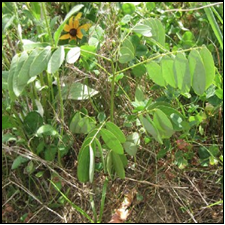
| Alternate (leaflets opposite) | Compound (pinnate) | 2-4 pairs of leaflets, some face upright; oblong or elliptic; prominent midvein | Senna hebecarpa | wild senna |
| Basal rosette (opposite when mature) | Simple | Lanceolate; some deeply lobed, appearing compound | Coreopsis lanceolata | lanceleaf coreopsis |
| Basal rosette (opposite when mature) | Simple | Start round, mature to lanceolate-elliptic | Oenothera fruticosa | narrow-leaved sundrops |
| Basal rosette (opposite when mature) | Simple | Oval with petiole; purple-red margins | Penstemon digitalis | tall white beardtongue |
| Basal rosette (when mature, mostly alternate) | Simple | Ovate to lanceolate; long petioles | Echinacea purpurea | purple coneflower |
| Basal tuft (grass-like) (alternate when mature) | Simple | Linear, narrow, sessile, no hairs, prominent midvein | Liatris spicata | blazing star |
| Basal rosette (alternate when mature) | Simple | Oval, hairy, with petiole | Rudbeckia hirta | black-eyed Susan |
| Basal rosette (alternate when mature) | Simple | Ovate or lanceolate; long
petioles; bluish |
Symphyotrichum laeve | smooth blue aster |
| Basal rosette (alternate when mature) | Simple | Oval; sessile; hairy | Symphyotrichum novae-angliae | New England aster |
| Basal rosette (alternate when mature) | Simple | Oblanceolate; sessile; bluish | Symphyotrichum oblongifolium | aromatic aster |
| Basal rosette (alternate when mature) | Simple | Linear, sessile, long thin hairs, sticky sap; appears grass-like | Tradescantia ohiensis | Ohio spiderwort |
| Basal rosette (alternate when mature) | Compound
(pinnate – trifoliate) |
Round leaves, with petiole; zigzag margins | Zizia aurea | golden Alexanders |
| Opposite | Simple | Triangular or heart shaped; serrated margins; prominent midvein | Heliopsis helianthoides | oxeye sunflower |
| Opposite | Simple | Serrated, with petiole, visible midvein; red-purple underside; square stem | Monarda fistulosa | bee balm |
| Opposite | Simple | Lanceolate; narrow | Pycnanthemum tenuifolium | slender mountain mint |
| Whorled | Compound (pinnate) | Stemless, thread-like, divided into three segments | Coreopsis verticillata | threadleaf coreopsis |
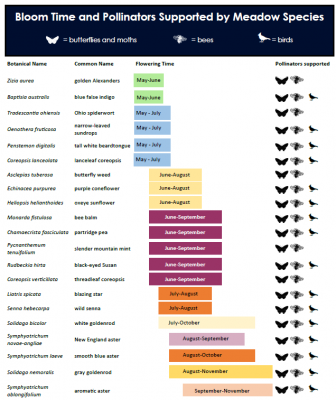
Bloom Time and Pollinators Supported by Meadow Species Chart –
full chart available on pg. 3 of the PDF version
Asclepias tuberosa — butterfly weed
Important monarch butterfly larval host plant. Readily self-seeds. Good soil drainage is essential. Difficult to transplant – taproot. Perennial.
- Attracts butterflies, moths, and bees.
- Soil moisture: dry to medium.
- Full sun. Deer resistant.

Identification
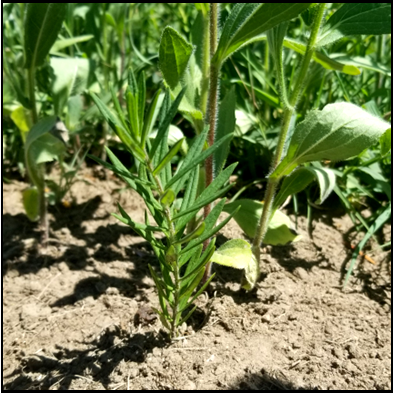
Seedling: Thick central stalk. Waxy, narrow, pointed, dark green leaves.
Mature: Height: 1-2.5’; Spread: 1-1.5’.
- Leaves: Oblong or lanceolate; glossy top leaf surface, lighter green and hairy on underside; toothless margins.
- Stems: Multiple, ascending, becoming hollow and hairy as the plant matures. Does not have milky sap typical of other milkweeds.
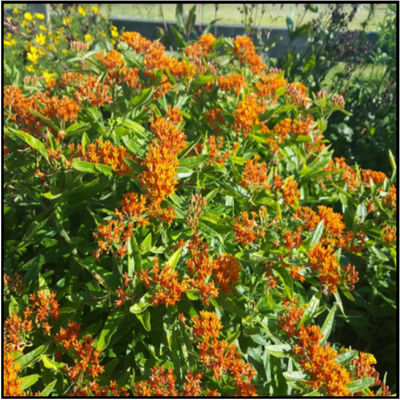
- Flowers: Orange umbels (June-August).
- Fruit: Seed pods (August-September) have ornamental value (Figure 1).

Baptisia australis — blue false indigo
Deep tap root and extensive root system. Tolerates drought and infertile soils. Does not respond well to transplanting. Attractive seed pods in fall. Perennial.
- Attracts butterflies, moths, birds, and bees.
- Soil moisture: dry to medium.
- Part to full sun. Deer resistant.
Identification
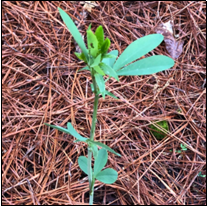
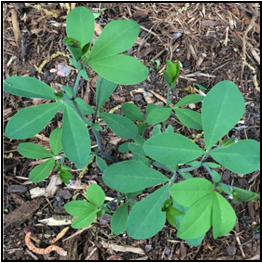
Seedling: 3 leaves compounded at distal point.
Mature: Height and spread: 3-4’.
- Leaves: Trifoliate, compound obovate, blue green; alternate, with smooth edges.
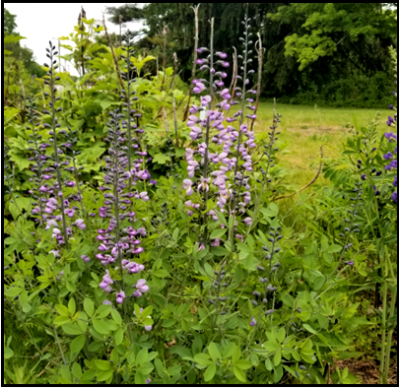
- Stems: Considerable branching.
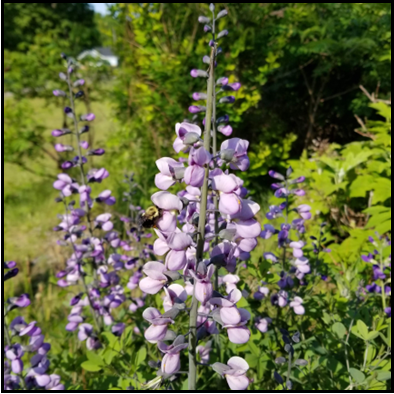
- Flowers: Blue or purple, pea-like, dense clusters on vertical spikes (May-June).
- Fruit: Ornamental green seed pods (Figure 2); mature to black. Good for dried flower arrangements.

Ornamental green seed pods (Figure 2); mature to black. Good for dried flower arrangements. Photo by Alyssa Siegel-Miles
Chamaecrista fasciculata — partridge pea
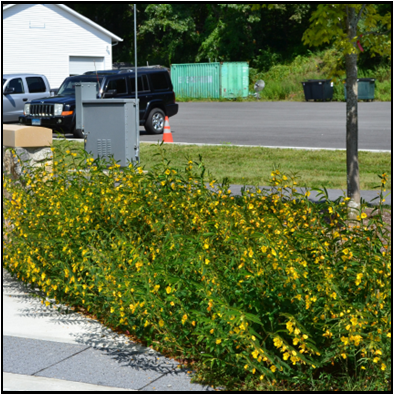
Butterfly larval host plant. Legume (fixes nitrogen; improves soil fertility). Used for erosion control. Seed in late March-May. Readily self-seeds. Annual.
- Attracts butterflies, moths, birds, and bees.
- Soil moisture: dry to medium. Part to full sun.

Identification
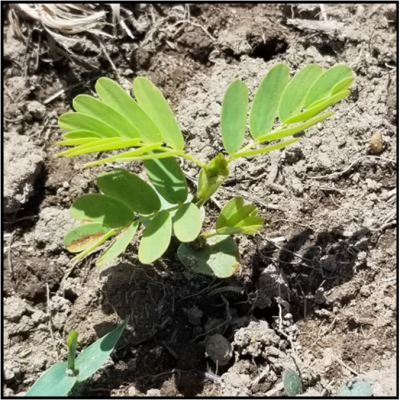
Seedling: Thin, light green, erect stems.
Mature: Height and spread: 1-3’.
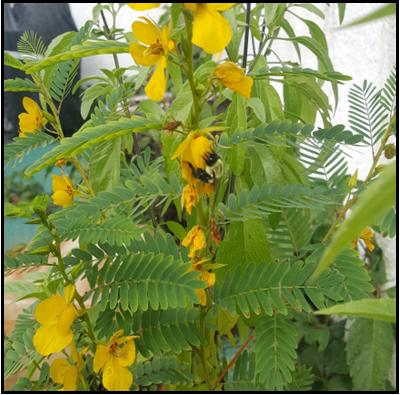
- Leaves: Pinnately-compound with small, yellow-green leaflets that are sensitive to touch. Up to 20 leaflets per leaf.
- Stems: Become reddish-brown as the plant matures. Tiny, reddish-orange glands on petiole produces nectar that attract insects.
- Flowers: Yellow, pea-like (June-September).
- Fruit: Seed pods in fall, initially hairy green (Figure 3); become hairless and dark brown. Good food source for gamebirds, songbirds.
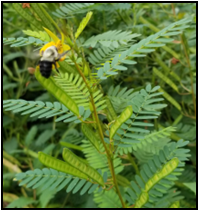
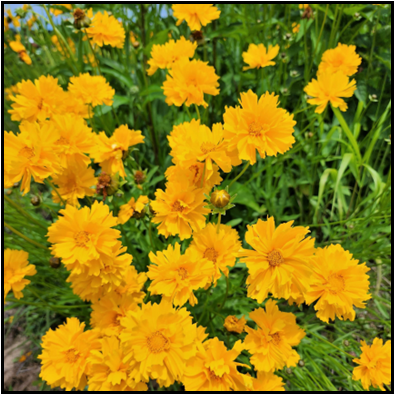
Coreopsis lanceolata — lanceleaf coreopsis
Butterfly, moth larval host plant. Grows well in heat and humidity. Drought tolerant. Forms extensive colonies; aggressive self-seeder. Deadheading will extend flowering. Short-lived perennial.
- Attracts butterflies, moths, birds, and bees.
- Soil moisture: dry to medium.
- Part to full sun. Deer resistant.
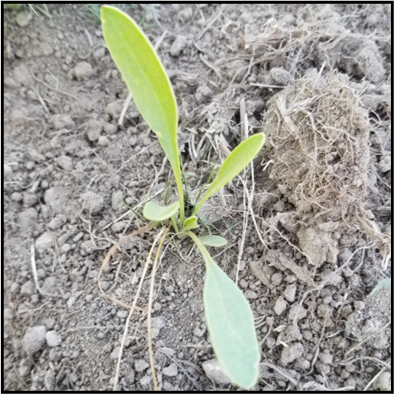

Identification
Mature: Height and spread: 1-2’.
- Leaves: Lanceolate, some deeply lobed, appearing almost compound. Basal rosette. Sparsely hairy. Opposite leaf arrangement in maturity. Leaves mostly in bottom half.
- Stems: Slender; multiple from base, growing in small clumps.
- Flowers: Yellow ray petals with light yellow central disc that gets darker with maturity, petals notched at tip (May-July).

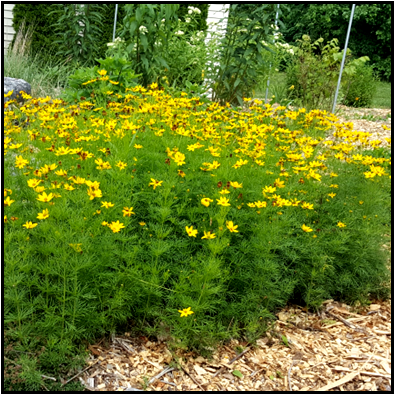
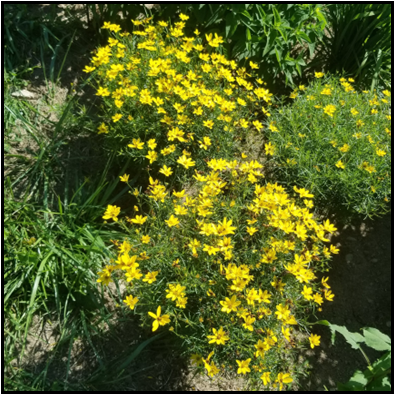
Coreopsis verticillata — threadleaf coreopsis
Attracts beneficial syrphid flies, yellow-collared scape moth. Drought tolerant. Good plant for infertile, dry soils. Grows in dense, bushy clumps. Reblooms in September if sheared lightly in August. Self-seeds. Perennial.
- Attracts butterflies, moths, and bees.
- Soil moisture: dry to medium.
- Part to full sun. Deer resistant.
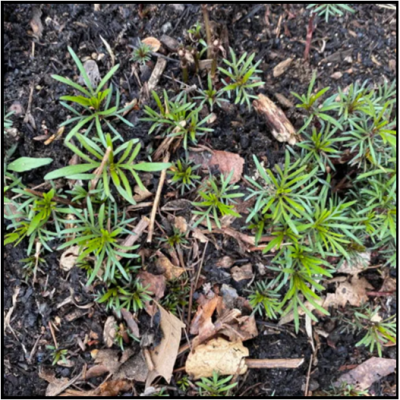

Identification
Mature: Height: 2-2.5’; Spread: 1.5-2’
- Leaves: Stemless, thread-like, dark-green, pinnately compound; divided into three segments; whorled.
- Flowers: loose clusters (cymes) of yellow ray petals with central disks; petals without notching (June-September).
- Stems: thin, green.
- Fruit: Dark achenes (July-October).
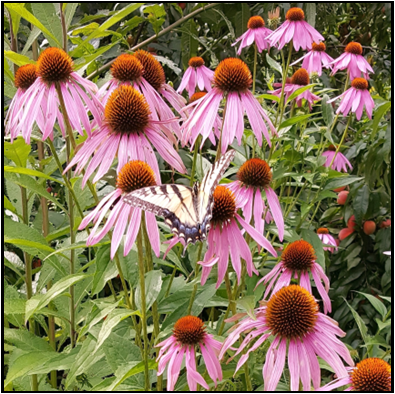
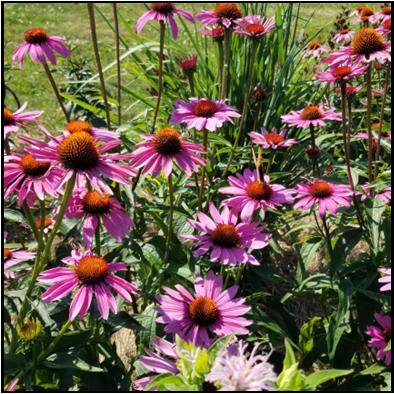
Echinacea purpurea — purple coneflower
Seeds are a good food source for birds. Long summer bloom. Multi-season interest. Mixes well with grasses. Drought resistant; tolerates infertile soil conditions. Self-seeds. Native to central to southeastern United States. Perennial.
- Attracts butterflies, moths, bees, and birds.
- Soil moisture: dry to medium.
- Part to full sun. Deer resistant.
Identification
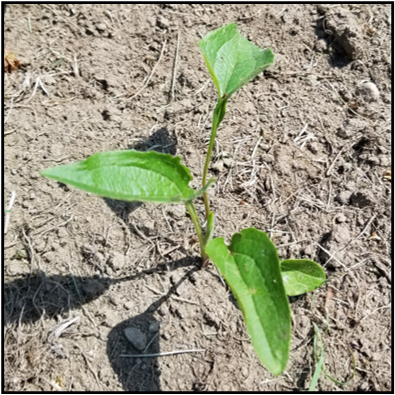
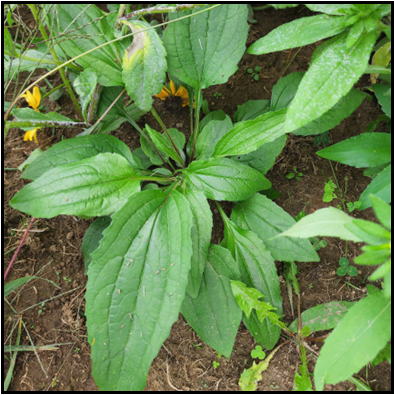
Seedling: Ovate to lanceolate leaves, on long petioles, grows from a basal rosette.
Mature: Height: 2-5’; Spread: 1.5-2’.
- Leaves: Thick, rough, lanceolate or obovate; smaller toward the top of the stem. Margins have widely spaced teeth. Petioles are short and slightly winged.
- Flowers: Pink-purple ray petals, orange-brown disk flowers in center (June-August).
Heliopsis helianthoides — oxeye sunflower
Seeds are good food source for birds. Readily self-seeds. Long summer bloom. Deadhead to extend bloom season. Short-lived perennial.
- Attracts butterflies, moths, birds (including hummingbirds), and bees.
- Soil moisture: dry to medium. Full sun.
Identification
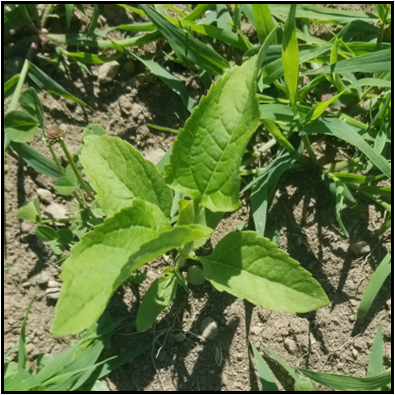
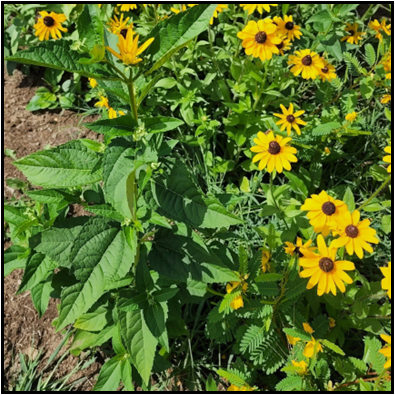
Seedling: Cotyledons round, margins entire. Leaves are simple, elongated triangle, with petiole, serrated margins, leaf hairs, and prominent midvein.
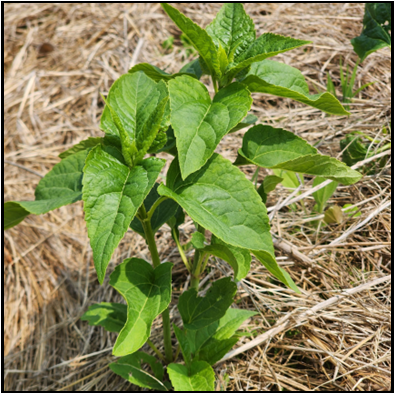
Mature: Height: 3-6’; Spread: 2-3’.
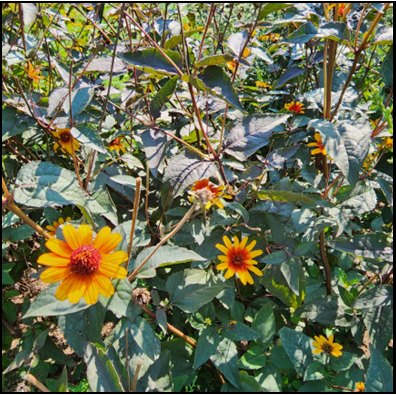
- Leaves: Paired, cordate (heart-shaped), with serrated edges and a coarse texture.
- Stems: Hairy, stiff, branched; oval in cross section.
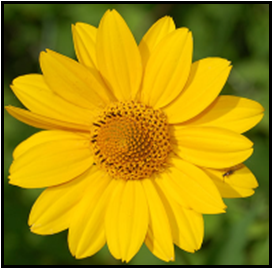
- Flowers: Orange-yellow ray petals with brown or golden disks (June-August). Alternating long and short bracts surround outer base of flower (Figure 4).

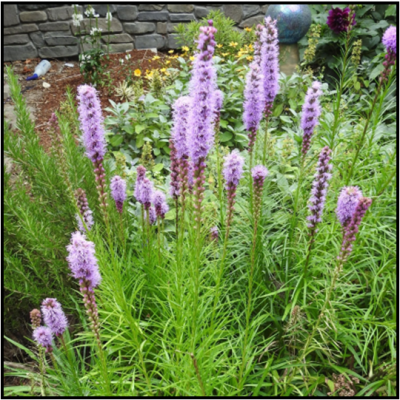
Liatris spicata — blazing star
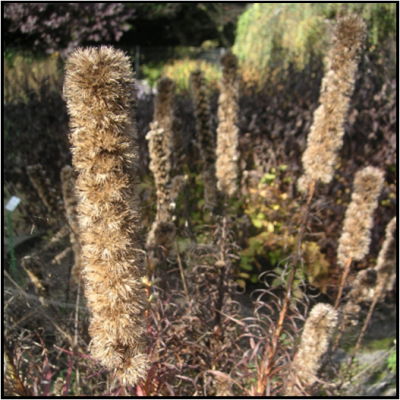
Seeds are a good food source for songbirds (e.g., goldfinches). Flower stalk adds attractive architectural interest. Drought tolerant. Intolerant of wet soils in winter. Reproduces via corms or seeds. Perennial.
- Attracts butterflies, moths, birds, and bees.
- Soil moisture: dry to medium. Full sun.

Identification
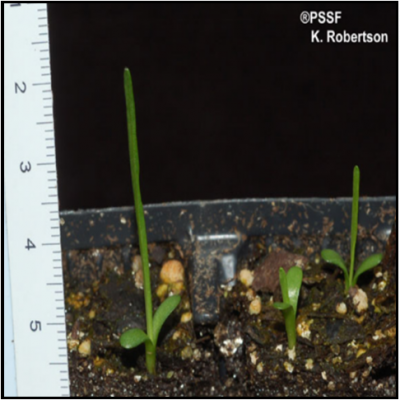
Seedling: Cotyledons oval, margins entire. Simple, linear, sessile leaves, no hairs, prominent midvein. One or more stalks emerge from a basal tuft.
Mature: Height: 2-4’; Spread: 0.75-1.5’
- Leaves: Narrow, grass-like, medium green, alternate; smaller higher up the stalk. Glabrous to sparsely hairy. Margins entire.
- Stems: Green, purplish.
- Flowers: Red-purple, dense, narrow spike; blooms from the top down (July-August).
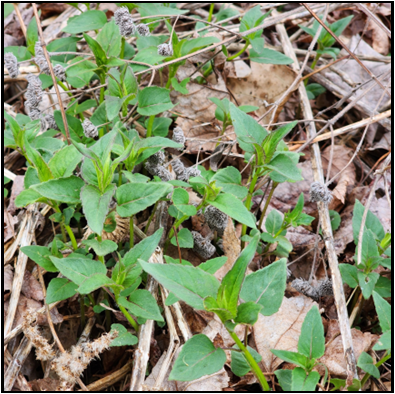
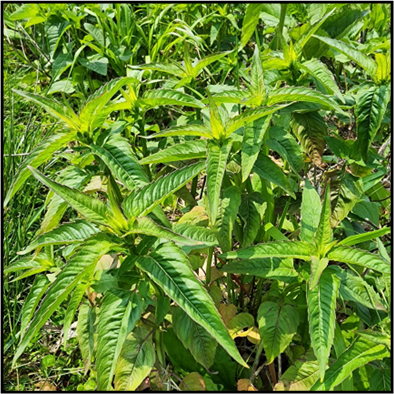
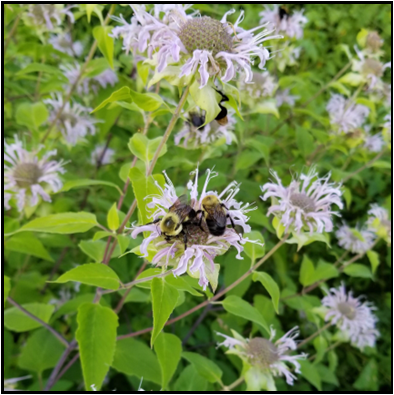
Monarda fistulosa — bee balm
Tubular flowers attract hummingbirds. Long summer bloom. Drought tolerant. Requires good air circulation to prevent foliar diseases; susceptible to powdery mildew. Perennial.
- Attracts butterflies, moths, birds, and bees.
- Soil moisture: dry to medium.
- Part to full sun. Deer resistant.
Identification
Seedling: Cotyledons round, margins entire. Leaves simple, serrated, no hairs; with petiole, visible midvein, red-purple underside.
Mature: Height: 2-4’; Spread: 2-3’.
- Leaves: Oblong, opposite, coarsely toothed; rounded at the leaf base, tapering to a point at the tip. Aromatic.
- Stems: Reddish-brown, square.
- Flowers: Pink-purple, two-lipped, tubular, rest on showy whorl of bracts (June-September).

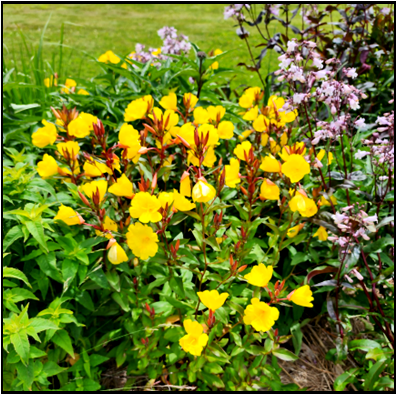
Oenothera fruticosa — narrow-leaved sundrops
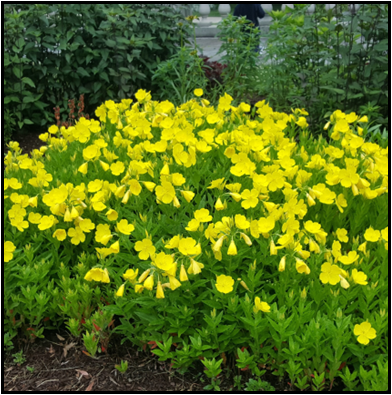
Forms colonies; spreads easily by rhizomes. Propagate by seed and cuttings. Intolerant of wet soils in winter. Perennial.
- Attracts butterflies, moths, birds (including hummingbirds), bees.
- Soil moisture: dry to medium.
- Full sun. Deer and rabbit resistant.
Identification
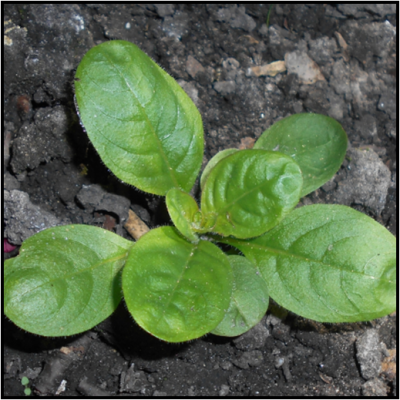
Seedling: Round leaves, sinuate or undulate margins. Basal rosette.
Mature: Height: 1.5-2.5’; Spread: 1-3’.
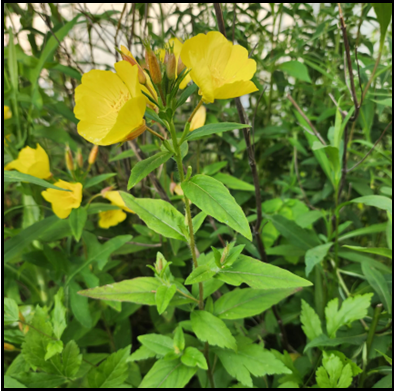
- Leaves: Basal leaves are lanceolate, 1-4” long; margins entire to slightly wavy; moderately to densely hairy. Stem leaves are opposite, shorter (.75-1.5”), narrow elliptical.
- Stems: Hairy with green or reddish hue.
- Flowers: Yellow, cup-shaped (May-July).
- Fruit: Distinctive club-shaped seed capsules evident from June-November.
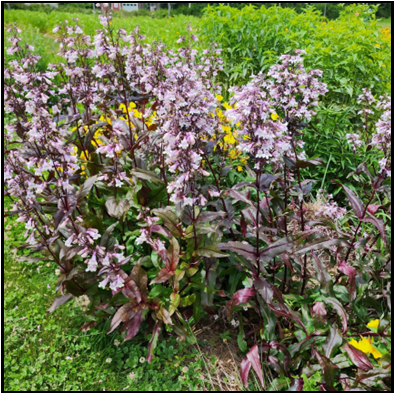
Penstemon digitalis — tall white beardtongue
Attracts hummingbirds. Late spring bloom. Drought tolerant. Quick grower. Exhibits clumping. Root rot may occur in wet, poorly-drained soils. Perennial.
- Attracts butterflies, moths, birds, and bees.
- Soil moisture: dry to medium.
- Full sun. Deer resistant.

Identification
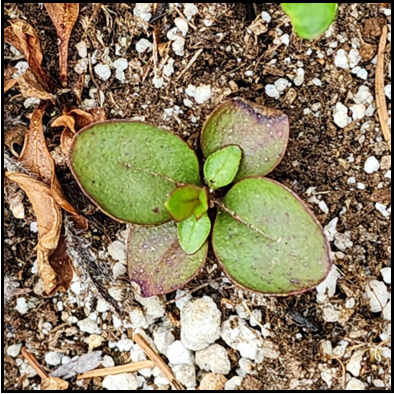
Seedling: Cotyledons oval, margins entire. Simple, oval leaves from basal rosette; with petiole, entire margins, prominent midvein and purple-red margins.
Mature: Height 3-5’; Spread: 1.5-2’.
- Leaves: Basal leaves elliptic; stem leaves lance or oblong, opposite.
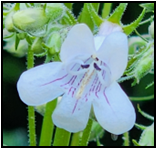
- Flowers: White, tubular in panicles; purple streaks direct pollinators (May-July).
- Stems: Slender, smooth, green to purple.
- Fruit: Ornamental seed capsules (Figure 5).
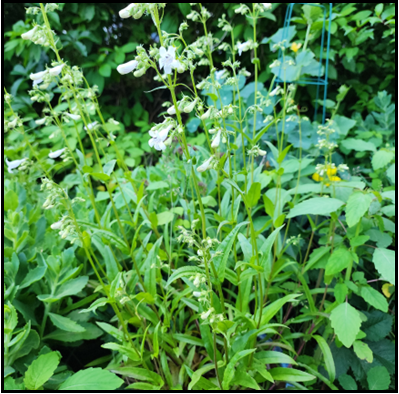
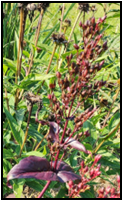
(Figure 5) Ornamental seed capsules. Photo by Alyssa Siegel-Miles
Pycnanthemum tenuifolium — slender mountain mint
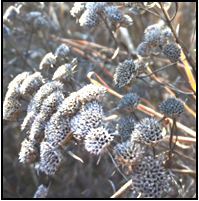
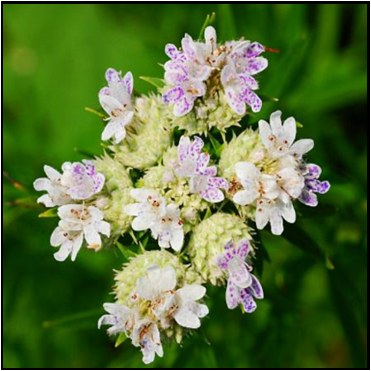
Excellent nectar source for pollinators. Appears delicate, fine-textured. Drought tolerant. Self-seeds. Spreads quickly, but not aggressively. Perennial.
- Attracts butterflies, moths, and bees.
- Soil moisture: dry to medium.
- Part to full sun.
Identification
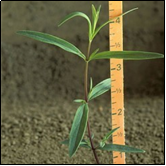
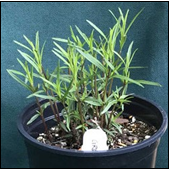
Seedling: Lanceolate leaves, becoming more slender as plant matures.
Mature: Height 2-4’; Spread: 2-3’.
- Leaves: Aromatic, opposite; numerous narrow leaflets. Branching occurs at the leaf axils.
- Stems: Smooth, square, purple-red.
- Flowers: White with purple spotting, borne at the top of the stems (June-September).
- Fruits: Nutlets. Ornamental dark gray seed heads provide fall-winter interest (Figure 6).

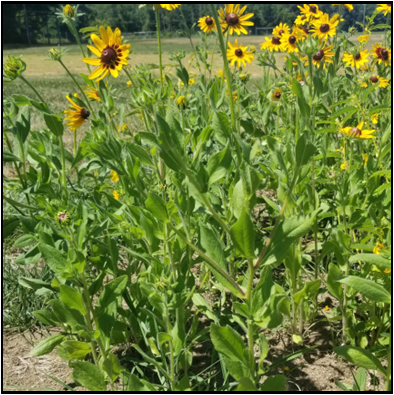
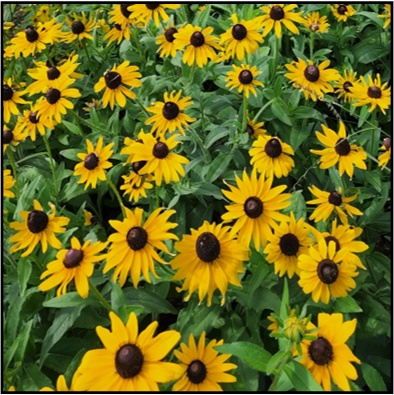
Rudbeckia hirta — black-eyed Susan
Use for early meadow establishment. Fast grower. Self-seeds freely. Long summer bloom extends into fall. Drought and salt tolerant. Susceptible to powdery mildew. Avoid overfertilization (will produce fewer flowers). Biennial.
- Attracts butterflies, moths, birds, and bees.
- Soil moisture: dry to medium.
- Part to full sun. Moderate deer resistance.
Identification
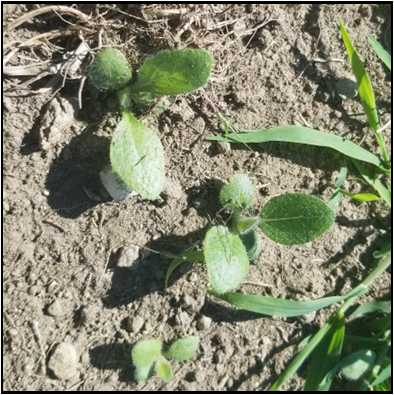
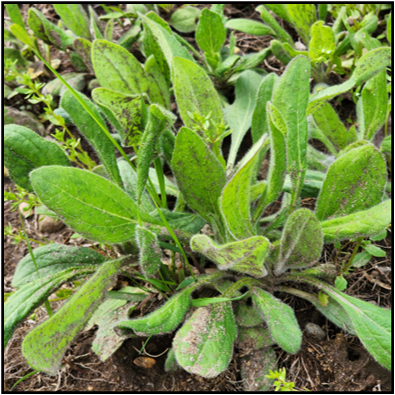
Seedling: Cotyledons oval, margins entire; basal rosette; simple, entire, oval, hairy leaves with petiole and prominent midvein.
Mature: Height: 2-3’; Spread: 1-2’.
- Leaves: Narrow, oblong, alternate, hairy; toothed or almost smooth margins. Lower leaves larger than top. Winged petioles.
- Flowers: Yellow ray petals with brown, domed center disks (June-September).
Senna hebecarpa — wild senna
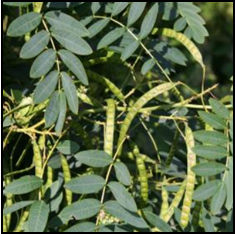
Host plant for sulphur butterflies. Versatile: attractive flower, foliage, and seed pods in fall and winter (Figure 7). Good fall color. Horizontal root system provides strength against winds. Can be used as a hedge. Legume (fixes nitrogen). Perennial.
- Attracts butterflies, moths, birds, and bees.
- Soil moisture: medium.
- Full sun. Deer resistant.
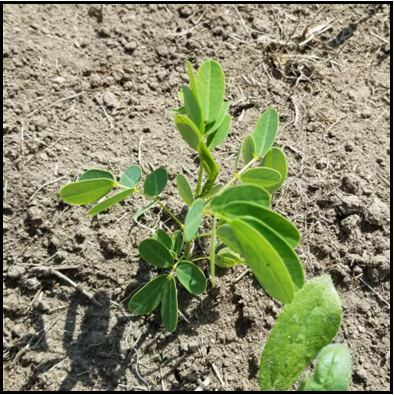
Identification
Mature: Height 4-6’; Spread: 3-4’.
- Leaves: Compound pinnate in pairs of 5-10, gray-green, alternate; leaflets oblong or elliptic with a pointed tip. Stipules and small, club-shaped gland at base of petiole.
- Stems: Light green; slightly hairy at top.
- Flowers: Yellow, becoming white as they mature (July-August).
- Fruit: Dark brown seed pods.

Solidago bicolor — white goldenrod
Butterfly larval host plant. Seeds are a desirable food source for birds. Showy flower. Long summer bloom extends into autumn. Drought and salt tolerant. Exhibits clumping. Perennial.
- Attracts butterflies, moths, birds, and bees.
- Soil moisture: dry.
- Part to full sun. Deer resistant.
Identification
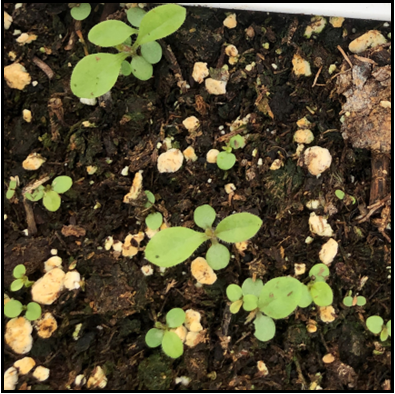
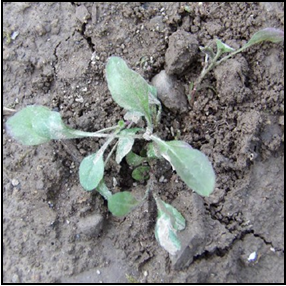
Seedling: Spatulate leaves.
Mature: Height: 2-3’; Spread: 1-2’.
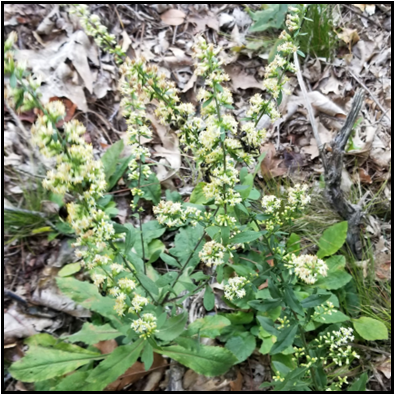
- Leaves: Hairy, elliptical; basal leaves shallowly toothed and with grayish down.
- Stems: hairy, grayish.
- Flowers: Spikes of white ray petals with a yellow center (July-October). Only goldenrod with white rays in the eastern U.S.

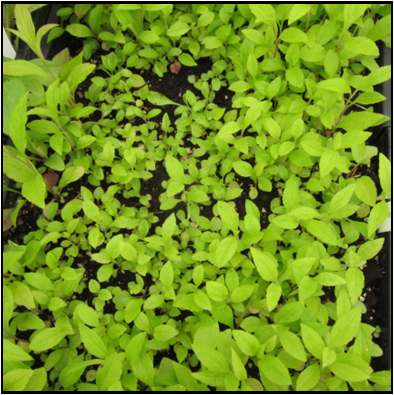
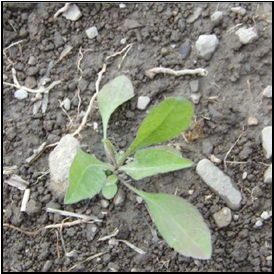
Solidago nemoralis — gray goldenrod
Blooms into late autumn. Drought resistant. Self-seeds and spreads rapidly, but not overly aggressively. Exhibits clumping. Showy flower. Perennial.
- Attracts butterflies, moths, birds, and bees.
- Soil moisture: dry.
- Part to full sun. Deer resistant.
Identification
Mature: Height and spread: 0.5-2’.
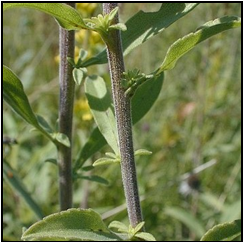
- Leaves: Elliptic or lanceolate; taper gradually to narrow petioles; hairy; may be toothed; smaller towards top of stem. Small clusters of secondary leaves often in axils of middle to upper leaves (Figure 8).
- Stems: Unbranched, curving at flower tip; hairy; reddish or grayish green.
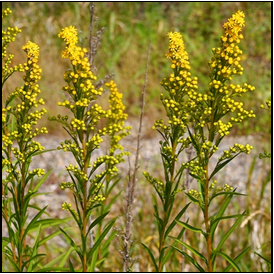
- Flowers: Yellow (August-November).
- Fruit: Achenes with hairy tufts (Figure 9).

Symphyotrichum laeve — smooth blue aster
Butterfly larval host plant. Autumn bloom. Fast grower; self-seeds. Susceptible to powdery mildew. Drought tolerant. Perennial.
- Attracts butterflies, moths, birds, and bees.
- Soil moisture: dry to medium.
- Full sun.
Identification
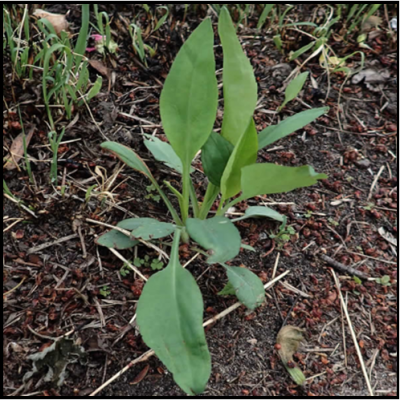
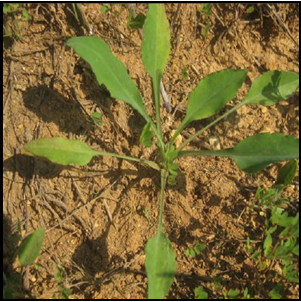
Seedling: Basal rosette of ovate or lanceolate leaves with long petioles.
Mature: Height: 2’-4’; Spread: 1’-2’.
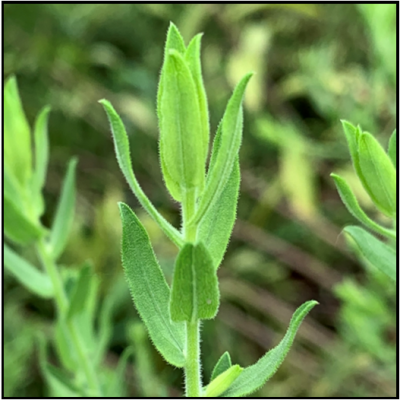
- Leaves: Alternate, simple, bluish; lance to egg-shaped; partly clasping stems. Smaller and closer together towards top of stem.
- Stems: Light green-light blue or purple, glabrous, and often glaucous.
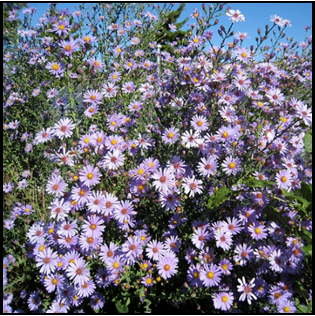
- Flowers: Panicle of blue or purple flowerheads with yellow disks (August-October).
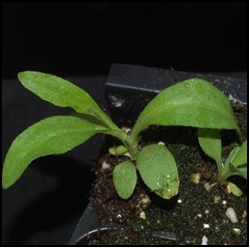
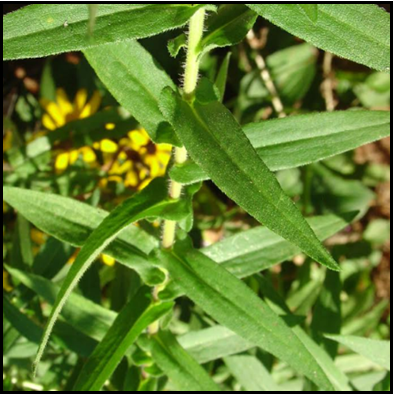
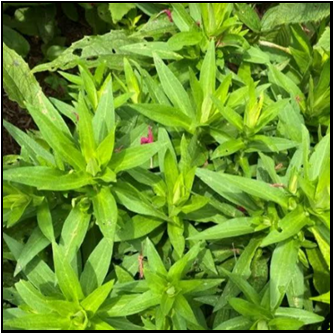
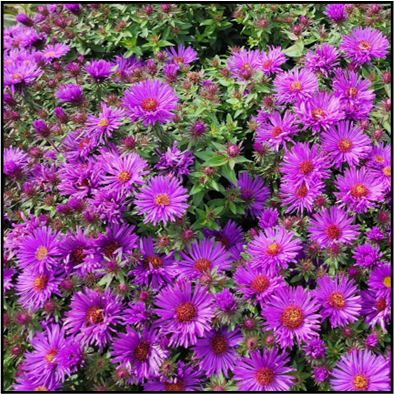
Symphyotrichum novae-angliae — New England aster
Butterfly larval host plant. Nectar source for monarch butterflies. Autumn bloom. Self-seeds. Showy flower. Requires good air circulation to prevent foliar diseases. Perennial.
- Attracts butterflies, moths, birds, and bees.
- Wide range of soil moisture tolerance.
- Full sun. Deer resistant.
Identification
Seedling: Cotyledons oval, margins entire. Simple, oval, sessile, hairy leaves.
Mature: Height: 3-6’; Spread: 2-3’.
- Leaves: Oblong or lanceolate, hairy, alternate; dense. Clasp stem at base of leaf. Smaller towards top of stem. Smooth margins; rough texture.
- Stems: Hairy. Central stem, with some branching at top.
- Flowers: Composite, in clusters of purple-blue ray petals with yellow disks (August-September).
Symphyotrichum oblongifolium — aromatic aster
Butterfly larval host plant. Showy bloom through late autumn. Resistant to drought and rabbit damage. Can be top heavy; may benefit from spring pruning or staking. Spreads via seed. Perennial.
- Attracts butterflies, moths, birds, and bees.
- Soil moisture: dry to medium.
- Full sun. Deer resistant.

Identification
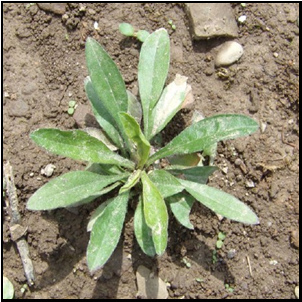
Seedling: Basal rosette.
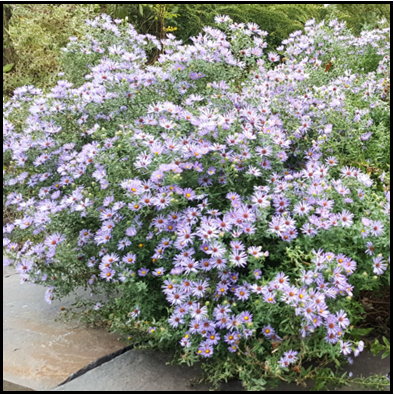
Mature: Height and spread: 1-3’.
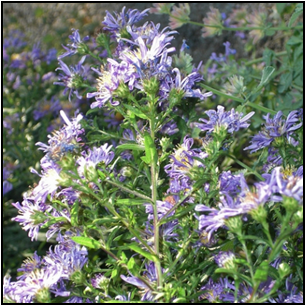
- Leaves: oblanceolate, bluish, sessile, slightly hairy, clasping, alternate. Densely crowded. Smaller towards top of stem. Aromatic.
- Stems: Stiff, slender, slightly hairy; dense branching, appears bushy. Lower stems turn brown and slightly woody with age.
- Flowers: Compound; purple ray petals with yellow disks that become reddish-purple.
Tradescantia ohiensis — Ohio spiderwort
Showy flower. Self-seeds aggressively. Prefers moist, acidic, sandy soil, but is highly adaptable. Tolerates part shade, but produces fewer blooms. Forms clumps. Can be propagated by division and cuttings. Perennial.
- Attracts butterflies, moths, and bees.
- Soil moisture: dry to medium.
- Part to full sun.
Identification
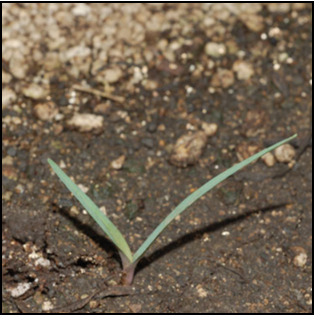
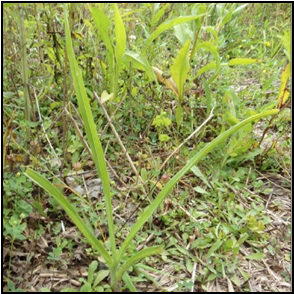
Seedling: Simple, linear, sessile leaves with entire margins, long thin hairs, and sticky sap. Appears grass-like.
Mature: Height: 2-3’; Spread: 1-2.5’
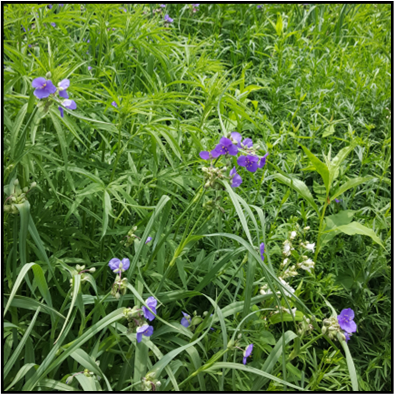
- Leaves: Simple, dark blue-green, linear, wider at base. Parallel venation. Lengthwise groove in center. Base of leaf clasps stem.
- Stems: Smooth; hairless; may be purplish.
- Flowers: Blue, tri-petaled (May-July); grow out of the leaf axil.

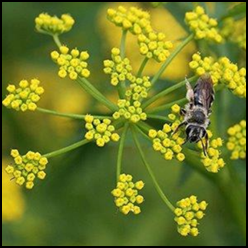
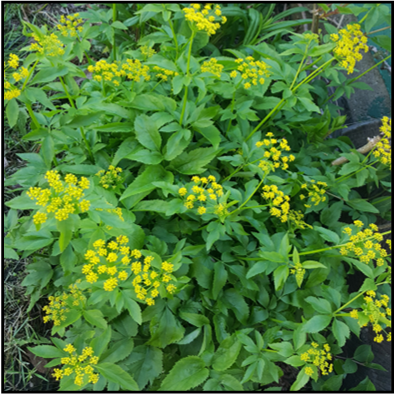
Zizia aurea — golden Alexanders
Perennial. Showy flowers. Self-seeds. Beautiful en masse. Can be used in meadows, rain gardens or border plantings. Grows in colonies. Tolerates dry soils.
- Attracts butterflies, moths, and bees.
- Soil moisture: medium; tolerates wide range.
- Part to full sun.
Identification
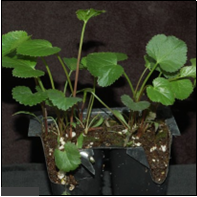
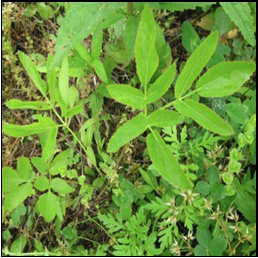
Seedling: cotyledons strap-like, margins entire. Simple, round leaves, with petiole, zigzag margins, no hairs.
Mature: Height: 1.5-2’; spread: 1-2’
- Leaves: Pinnately compound, trifoliate, serrated margins, with petiole. Purplish hue in the fall. Stems light green, hairless, shiny.
- Flowers: Yellow compound umbel (May-June).
- Fruit: Green capsules early to mid-summer; become light purple in autumn.
Glossary
Achene: a small, dry one-seeded fruit that does not open at maturity.
Alternate: leaf pattern arrangement with one leaf per node.
Annual: completes life cycle from seed to mature plant in one year.
Compound leaf: divided into several leaflets.
Cordate: heart-shaped leaf.
Cotyledon: an embryonic leaf in seed-bearing plants, one or more of which are the first leaves to appear from a germinating seed.
Distal point: far side from the place of attachment (shoot or root).
Elliptic: oval, with the widest part at or near the middle.
Entire: with a continuous, untoothed margin (leaf description).
Glabrous: smooth; not hairy or pubescent.
Glaucous: greyish or bluish waxy coating; usually rubs off easily.
Lanceolate: narrowly ovate. Wider at the base than at the middle, tapering toward the apex, at least 3 times as long as wide.
Larval host: a plant on which butterfly or moth females lay eggs, so that their larvae can then feed on the plant after hatching. Many species require specific plants for their larvae to feed on to survive.
Margin: edge of a leaf.
Nectary: plant gland that secretes nectar, usually located at base of flower stamens; draws pollinators into contact with the pollen.
Node: the joint of a stem; region of attachment of leaves to a stem.
Oblong: longer than broad; sides nearly parallel, rectangular with rounded edges.
Obovate: broader part at apex/above the middle, rather than base.
Ovate: broader at the base; gradually tapering to a rounded tip.
Opposite: leaf arrangement with two leaves per node.
Perennial: lives for more than two years. Returns each year; continues growing until reaching maturity.
Petiole: the stalk between the leaf blade and the stem.
Pinnately compound: divided into smaller leaflets; leaflets arranged on each side of leaf’s central stalk/rachis.
Rosette: circular arrangement of leaves; grows from base.
Sessile: stalkless and attached directly at the base (e.g., sessile leaf).
Stipule: small, usually leaflike appendage at base of the petiole, often in pairs.
Serrated: margin notched like a saw, with sharp teeth pointing toward the tip.
Simple leaf: a leaf blade that is all one piece; may be deeply lobed or divided, but not separated in leaflets.
Sinuate: A sinuate margin has shallowly rounded divisions within the same plane of the blade.
Trifoliate: having three leaves, leaflike parts, or (of a compound leaf) leaflets.
Umbel: an inflorescence, made up of many tiny flowers with stalks of nearly equal length that radiate from a common point to form a flat or rounded flower cluster.
Undulate: an undulate margin has wavy margins that occur above and below the plane of the leaf.
Whorled: three or more equally spaced leaves at a node.
References and Resources
Clark, M. 2020. Who has the Blues? Under the Solano Sun, University of California. ucanr.edu/blogs
Clemson University College of Agriculture, Forestry, and Life Sciences. Symphyotrichum oblongifolium: Aromatic Aster. clemson.edu/cafls/demo/plant_profiles/symphyotrichum-oblongifolium.html
Connecticut Butterfly Association. 2007. Life Histories of Connecticut Butterflies. ctbutterfly.org
Connecticut Department of Energy and Environmental Protection Bureau of Natural Resources. 2015. Connecticut’s Endangered, Threatened, and Special Concern Species. portal.ct.gov/-/media/DEEP
Cornell University Growing Guide: Coreopsis, Threadleaf. gardening.cornell.edu/homegardening
Eastern Illinois University. Prairie Restoration Digital Aid: Seeds, Seedlings, and Fruits. castle.eiu.edu/prairie
Finger Lakes Native Plant Society. flnps.org/seedlings
Go Botany. Simple and Advanced Plant ID. gobotany.nativeplanttrust.org
Greenfield Community College Robert L. Pura Outdoor Learning Laboratory. Purple Coneflower. gcc.mass.edu/oll/plants/purple-cone-flower
Greiner, S. & Köhl, K. (2014). Growing evening primroses (Oenothera). Frontiers in Plant Science, 5, 38–38. doi.org/10.3389/fpls.2014.00038
Illinois Wildflowers. illinoiswildflowers.info
Lady Bird Johnson Wildflower Center, The University of Texas. wildflower.org
Minnesota Wildflowers. minnesotawildflowers.info
Missouri Botanical Garden. missouribotanicalgarden.org
Missouri Plant Foundation. Slender Mountain Mint. grownative.org/project/slender-mountain-mint
Native Plant Trust. nativeplanttrust.org
Neal, C. 2019. Planting for Pollinators: Establishing a Wildflower Meadow from Seed. University of New Hampshire Extension. extension.unh.edu
North Carolina State University Extension Gardener Plant Toolbox. plants.ces.ncsu.edu/find_a_plant
Roos, D. Pollinator Garden Videos. North Carolina State University Extension. growingsmallfarms.ces.ncsu.edu/growingsmallfarms-garden-videos
Stoner, K. A Citizens’ Guide to Creating Pollinator Habitat in Connecticut. CAES. portal.ct.gov
United States Department of Agriculture Forest Service. fs.usda.gov
United States Department of Agriculture Natural Resource Conservation Service. nrcs.usda.gov
University of Illinois Extension Wildflowers. web.extension.illinois.edu/wildflowers/default.cfm
University of Massachusetts Herbarium. ag.umass.edu/landscape/publications-resources/weed-herbarium
University of New Hampshire Extension. Asclepias tuberosa, Butterfly Milkweed. Heliopsis helianthoides, Ox-Eye Sunflower. Monarda fistulosa, Wild Bergamot. Rudbeckia hirta, Black Eyed Susan. extension.unh.edu
University of New Hampshire Extension. Wildflower Meadows. extension.unh.edu/agriculture-gardens/landscaping/wildflower-meadows
University of Rhode Island. East Farm Pollination Research Project. web.uri.edu/mastergardener/pollination-meadow/
University of Wisconsin Horticulture. Butterflyweed, Asclepias tuberosa. hort.extension.wisc.edu/articles/butterflyweed-asclepias-tuberosa/
Wallace, V. and A. Siegel-Miles. 2021. Connecticut Native Plant and Sustainability Guide. University of Connecticut Extension. s.uconn.edu/UConnNativePlantGuide
Zarrillo, T. The Connecticut Bumble Bee Guide. CAES. portal.ct.gov
Download a PDF version of this article
UConn Extension is committed to providing equal access and full participation for individuals with disabilities within all our programs and activities. Visit s.uconn.edu/accessibility for more resources. UConn complies with all applicable federal and state laws regarding non-discrimination, equal opportunity, affirmative action, and providing reasonable accommodations for persons with disabilities. Contact: Office of Institutional Equity; (860) 486-2943; equity@uconn.edu; equity.uconn.edu.
© UConn Extension. All rights reserved. Updated June 2023. Funds to support the creation of this document were provided by the Crop Protection and Pest Management Extension Implementation Program [grant no. 2017-70006-27201/project accession no. 1013777] from the USDA National Institute of Food and Agriculture.